Tag: Vetiver System

Floating Islands That Work

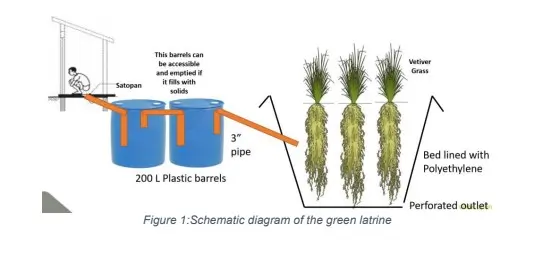
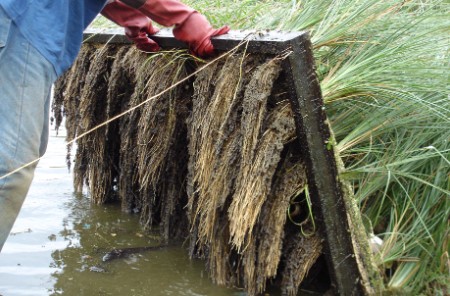
Floating Islands That Work: TVNI’s Revised Vetiver Floating Island Specification v2.1 A Vetiver Floating Island is a simple idea: a buoyant raft planted with vetiver grass, anchored on a polluted pond or lagoon, with the plant’s dense vertical roots hanging…

The Hedge that Builds Itself

A reader’s guide to the Vetiver Hedge Mechanisms standard, for members who do not build slopes for a living Our design standard guide  Vetiver Hedge Mechanisms now runs to a hundred pages and eighteen annexes, and parts of it are…

The Vetiver System for Stream Bank Stabilisation

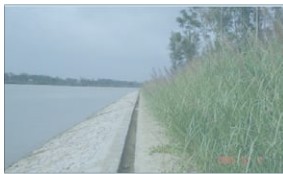
The two attached documents make a complementary case for the Vetiver System (VS) as a living, low-cost means of protecting river, canal, dam and sea banks against flood and wave erosion. The first sets out the underlying method and a…

NEWSLETTER (NL2026-05): The $3 Revolution: Proving What Vetiver + AMF Can Really Do at Scale

This might be the most important post I write this year, and I'm going to be direct about why: We have something potentially extraordinary in our hands—a Vetiver- Arbuscular Mycorrhizal Fungi (AMF) partnership that research suggests could deliver 70-85% nematode...

Bridging the Adoption Gap: TVNI’s 2026 Engineering Standards for Slope Stabilization

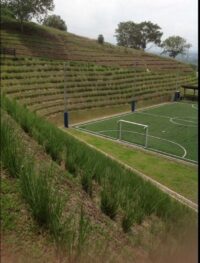
For three decades, Vetiver Grass Technology (VGT) has demonstrated extraordinary technical performance in stabilizing engineered slopes—yet struggled with institutional adoption. Hong Kong documented ten years of zero slope failures, then rejected vetiver. Hawaii faced $70 million in flood damage and…

Become a Farmer-Researcher: Six Vetiver System Models to Transform Your Farm

An Invitation to Farmers and Other Vetiver Users Choose Your Path, Document Your Journey, Share Your Knowledge What if the greatest agricultural research wasn’t happening in laboratories, but on your farm? What if farmers like you—working the land, observing the…

Vetiver’s phytoremedial mechanism, and how it might mitigate water pollution in tropical countries with India as an example

Vetiver Phytoremediation – The  Mechanisms Vetiver grass (Chrysopogon zizanioides) removes agricultural and waste water (sewage) pollutants through four integrated biological mechanisms operating simultaneously. (1) The foundation is its massive vertical root system reaching 3-4 meters depth, creating enormous surface area…

NEWSLETTER (NL2026-04) The 9-Degree Solution: What Vietnamese Farmers Discovered (And Science Had Already Proven}

Welcome to an extraordinary month in the Vetiver world. From Vietnamese farmers making remarkable discoveries to Brazilian associations taking flight, from Ethiopian insights finally being understood to engineering breakthroughs that challenge conventional thinking—this month reveals vetiver’s true power not just…

HOW VETIVER ACTUALLY IMPROVES SOIL FERTILITY

Think of degraded soil at 1.5% organic matter barely supporting crops. Now imagine bringing it to 4.3%. That’s what Anno Farms in Ethiopia achieved over 15 years with vetiver. Not guesswork—measured data from a 200-hectare commercial operation. Here’s how: THE…

 The Soil Temperature Crisis: Climate Change Impact on Global Food Crops

Comprehensive Assessment of Staple Grains, High-Value Perennials, and Vegetable Crops Under Rising Soil Temperatures—and the Vetiver Solution The Crisis Beneath Our Feet While the world fixates on rising air temperatures, bare degraded soil now reaches 43-50°C during peak sun versus…