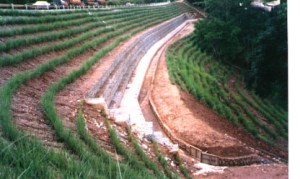
For three decades, Vetiver Grass Technology (VGT) has demonstrated extraordinary technical performance in stabilizing engineered slopes—yet struggled with institutional adoption. Hong Kong documented ten years of zero slope failures, then rejected vetiver. Hawaii faced $70 million in flood damage and eleven landslides, then chose conventional metal soil nails over vetiver for Kuhio Highway repairs. China scaled vetiver to over 9 million square meters across massive infrastructure programs, only to see application rates collapse when crisis pressure released. Vietnam succeeded where others faltered—not through better technical data, but by accepting partial solutions and learning-by-doing within existing procurement frameworks.
The pattern is clear: adoption barriers are structural, not evidentiary. Proof of performance does not translate into standard practice when procurement systems favor familiar solutions, liability frameworks demand precedent, and cross-professional complexity creates implementation friction.
TVNI’s 2026 Slope Stabilization documentation package represents a strategic response to this challenge. Rather than adding more technical evidence, these standards provide the institutional scaffolding that allows government agencies and infrastructure organizations to confidently adopt VGT within their existing engineering, procurement, and risk management systems.
An Integrated Implementation Pathway
The package comprises five core documents that progress from foundational knowledge through advanced engineering design to field execution, formal procurement, and institutional strategy:
At the foundation lies Dr. Mohammad Shariful Islam’s comprehensive 126-page Standard Specification (Bangladesh University of Engineering and Technology)—the essential technical and biological knowledge base covering vetiver morphology, root mechanics, hydraulic principles, and testing protocols that underpins all subsequent specifications.
Building on this foundation, TVNI’s Advanced Engineering Specification operationalizes these principles for complex engineered slopes, integrating bio-hydro-mechanical design rules, geofabrics decision matrices (positioned as “targeted add-ons, not defaults”), and China’s (Feng Ziyuan) microbial dipping breakthrough that delivers 20-40% higher survival rates and eliminates establishment uncertainty.
For field implementation, the Slope Stabilization Template converts engineering parameters into practitioner-friendly checklists with numeric placeholders, ensuring advanced design translates into verifiable installation procedures. The Two-Tier Procurement Specification then formalizes these field procedures for both simple and complex slopes as contract-ready requirements with payment terms and acceptance criteria suitable for government tender processes.
Finally, the Adoption Barriers & Strategic Response document synthesizes thirty years of implementation evidence—revealing why technical success alone proves insufficient and how these standards are deliberately structured to address the institutional obstacles that constrained previous adoption efforts.
Designed for Confident Adoption
These standards do more than document what vetiver does. They provide risk-based decision matrices that create defensible processes for engineering approval. They frame geofabrics integration diplomatically while maintaining biological primacy. They translate “learning-by-doing” into “documented decision protocols following published standards”—the language procurement and liability frameworks accept. They shift burden of proof by documenting fifteen countries across four continents, forcing the question: why isn’t this sufficient evidence?
For infrastructure agencies seeking nature-based solutions that integrate seamlessly with conventional engineering practice, this package provides everything needed to pilot VGT defensibly, learn systematically, and scale confidently. It represents not just technical documentation, but institutional bridge-building—the missing link between proven performance and standard practice.
Download the complete package and supporting application-specific specifications HERE