Welcome to an extraordinary month in the Vetiver world. From Vietnamese farmers making remarkable discoveries to Brazilian associations taking flight, from Ethiopian insights finally being understood to engineering breakthroughs that challenge conventional thinking—this month reveals vetiver’s true power not just as erosion control, but as agricultural infrastructure with hidden benefits that science documented decades ago, yet farmers are only now beginning to see.
The Hidden Benefits of Vetiver: When Farmers Discover What Science Had Already Proven
The Vietnamese Discovery
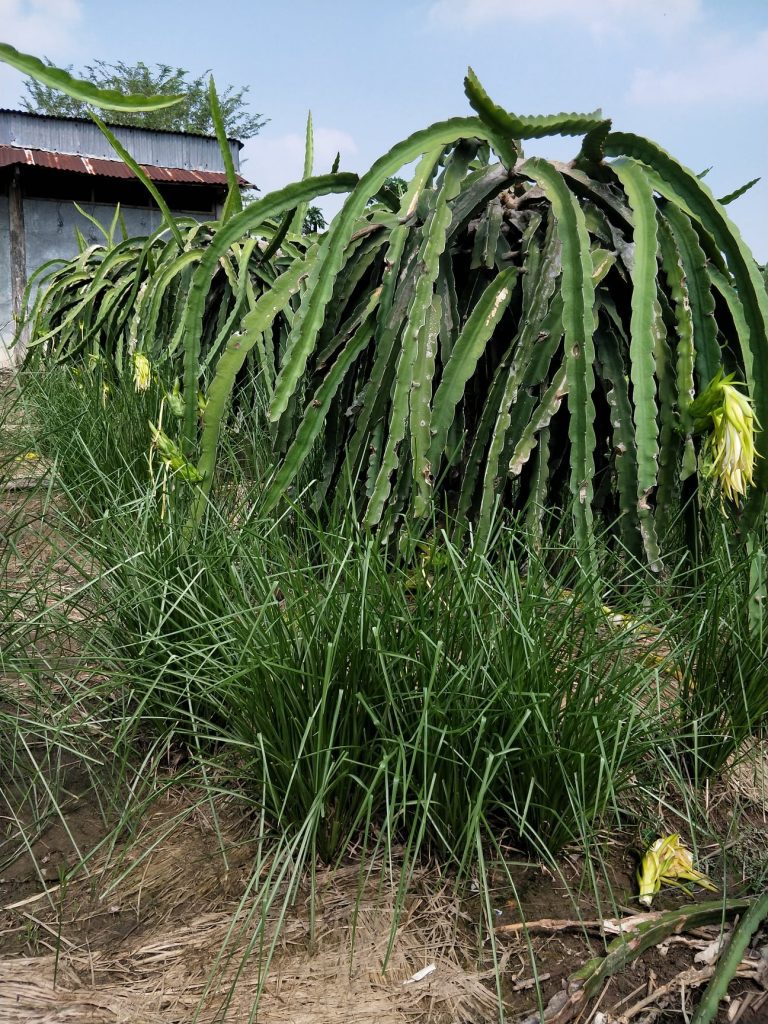
The Vietnam Vetiver Farmers Group has become the world’s most innovative vetiver community through careful field observation and documentation. Their farmers noticed something remarkable: crops planted close to vetiver hedges—particularly papaya, dragon fruit, citrus, and grapes—grew with exceptional vigor and health. The farmers attributed this dramatic improvement to vetiver ‘wicking up’ deep moisture and making it available to nearby plants.
While their moisture theory was incorrect, their observations were absolutely right—something profound was happening. The connection they hadn’t made was that papaya, dragon fruit, and grapes are all highly susceptible to nematode damage. Unknown to the Vietnamese farmers, research conducted decades earlier had already documented vetiver’s powerful nematode-suppressing properties and other hidden benefits. The probability that these hidden mechanisms explained what the farmers were seeing is extremely high. This story illustrates both the power of careful farmer observation and the critical importance of making existing research accessible to practitioners in the field. Extension staff and others need to be more active in analyzing research results and putting them to use.
Five Hidden Mechanisms Working Beneath the Surface
- Dramatic Reduction in Nematode Populations
Research conducted years before the Vietnamese observations showed that vetiver reduces nematode populations by up to 1,000-fold within a two-to-three-meter radius. This protective zone is particularly valuable for crops highly susceptible to root-knot nematodes: dragon fruit, papaya, passion fruit, grapes, black pepper, tomatoes, chilies, yams, sweet potatoes, and turmeric. The mechanism involves biochemical compounds released by vetiver roots that repel or inhibit nematode reproduction. When Vietnamese farmers saw their papaya and dragon fruit thriving near vetiver, they were witnessing this nematode suppression in action—they just didn’t know it yet….. more
- Natural Trap Crop for Stemborers
Research from China and South Africa documented that vetiver functions as a ‘dead-end’ trap crop for rice and maize stemborers. The plant’s volatile compounds attract stemborer moths to lay eggs preferentially on vetiver leaves. When larvae hatch and begin feeding, specific chemicals in vetiver tissue destroy their digestive enzymes, preventing successful development. This breaks the pest’s reproductive cycle without any chemical intervention. In China, over 200,000 hectares of rice is estimated to be protected against stem borer by vetiver, resulting in dramatically reduced pesticide use. more
- Habitat for Beneficial Parasitoid Wasps
Vetiver hedgerows provide critical habitat for parasitoid wasps—tiny beneficial insects that lay their eggs inside pest eggs or larvae. These wasps naturally control stemborers of maize, sorghum and rice, as well as Coffee Berry Borers (affecting coffee), and False Codling Moths (attacking avocados and citrus). Mature hedges offer the structural complexity, micro-climate stability, and nectar sources these beneficial insects require. The key insight: maintain at least one uncut hedgerow per field to preserve year-round habitat and ensure continuous biological pest control. more
- Extensive Mycorrhiza Fungal Networks
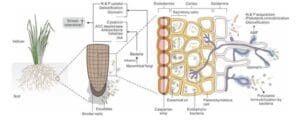 Vetiver roots host exceptionally dense networks of arbuscular mycorrhiza fungi (AMF). These beneficial fungi extend up to 15 meters from each vetiver plant, forming underground connections with nearby crops. Through these fungal networks, plants share water, nutrients (particularly phosphorus and micro-nutrients), and even chemical defense signals. Essentially, vetiver creates an underground resource-sharing cooperative. Vetiver responds strongly because its dense root system provides ideal habitat for microbial colonization. Farmers can enhance this effect by dipping vetiver slips in homemade microbial inoculant before planting. more
- Enhanced Water Infiltration and Deep Moisture Conservation
Vetiver’s massive, deep root system creates extensive macropore networks that dramatically improve water infiltration. These biological channels allow rainwater to penetrate deeply into the soil profile rather than running off the surface. The deep roots access moisture stored well below the reach of most crops, and this moisture spreads laterally through the soil. Additionally, vetiver hedges trap fine soil particles, creating localized perched water tables that maintain soil moisture during dry periods. This combination—improved infiltration, deep moisture storage, and lateral moisture distribution—creates a water conservation system that extends several meters from each hedge. This was likely what Vietnamese farmers observed as improved crop performance, though the mechanism involves much more than simple ‘wicking.’ more
Voices from the Field: Ethiopia’s Experience
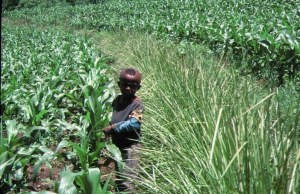
An Ethiopian practitioner involved in Africa’s largest smallholding contiguous vetiver program in the 1990s recently reflected on what they observed but didn’t fully understand at the time:
“Truly speaking, we have not noticed this (stem borer control). We appreciated the development of the hedges and their impact on water and soil conservation. The maize stand overall was amazing, and the leaves were deep green. At times, most of the (other) maize fields were infested by stemborers. However, maize planted in between vetiver hedges were free of this pest.”
Like the Vietnamese farmers, the Ethiopians saw clear benefits—spectacular maize growth and freedom from stemborer damage—but attributed it entirely to water and soil conservation. They didn’t realize they were witnessing the stemborer trap crop mechanism and possibly nematode suppression as well. The hidden benefits were there all along, quietly working beneath the surface.
The Soil Temperature Crisis: How Vetiver Actually Cools Your Farm
The Crisis Beneath Our Feet
While the world fixates on rising air temperatures, a hidden crisis is unfolding beneath our feet. Bare degraded soil now reaches 43-50°C during peak sun—temperatures that literally cook plant roots alive. This isn’t theoretical. This is the thermal reality facing farmers worldwide, and it’s the primary reason crops are failing even when rainfall appears adequate.
The Vanya Farm Evidence: Twenty-five years of satellite thermal analysis of India’s Vanya Farm documented the same piece of land measuring 50°C in 2000-2003 when it was bare and degraded. After transformation into a food forest, that same land cooled to 40-42°C—a 9°C absolute decline achieved through vegetation alone—while the surrounding landscape remained at 48-50°C. This wasn’t gradual climate change. This was deliberate biological engineering of the thermal environment.
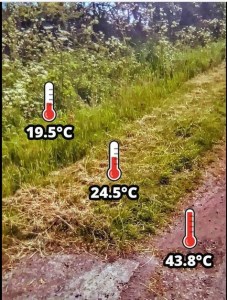 Here’s the critical insight: Vetiver delivers identical cooling through the same mechanisms—evapotranspirational cooling, moisture retention, canopy shading, improved soil structure, and enhanced organic matter—but with dramatically accelerated establishment. What took Vanya Farm 20 years of careful succession, vetiver achieves in 2-3 years. This 20-25°C difference between bare degraded soil and vetiver-protected soil is the difference between agricultural survival and collapse.
Five Interconnected Cooling Mechanisms
Vetiver doesn’t cool soil through one mechanism—it deploys five interconnected thermodynamic and hydrological processes simultaneously:
The Water Trick: Vetiver’s 3-5 meter roots punch deep channels into hardpan. Rain that used to run off now soaks 2-18× faster. Wet soil equals cool soil (like how sweating cools your body). Field moisture increases by 30-80%, and that moisture moderates temperature 24/7.
The Living Air Conditioner: That massive 2-meter tall canopy is transpiring constantly—pulling water from deep in the soil and evaporating it through leaves. Every liter evaporated removes huge heat energy. It’s literally air conditioning powered by groundwater.
The Shade Effect: Dense vetiver clumps shade the soil within 0.5-1.5 meters. Direct sun hitting bare soil reaches 50°C. Same sun hitting vetiver then soil drops to 45°C. Simple but effective during peak hours.
 The Sponge Layer: As roots grow and die, they continuously add organic matter to the soil—studies suggest approximately 1 ton per hectare annually of stable soil organic carbon. When vetiver tops are cut and used as mulch (up to 130 tons dry matter per hectare per year under optimal tropical conditions), this dramatically accelerates organic matter incorporation. Temperature swings flatten out.
The Air Gap Insulation: Better soil structure creates more air pockets between particles. Air is a terrible heat conductor (that’s why insulation works). Heat can’t penetrate as deep into the root zone.
The gradient? Right at the hedge (0-1m): 3-5°C cooler. Near the hedge (1-3m): 1-3°C cooler. Whole field: 0.5-2°C cooler. Add mulch from cut vetiver and gain another 3-5°C from physical insulation for a total 6-10°C reduction.
What this means for your crops: Coffee roots fail at 45°C. Papaya roots shut down at 43°C. Grape nematode resistance breaks down above 27°C. Banana leaves scorch above 38°C. Guava’s shallow roots sitting in 50°C bare soil simply cannot function—the plant shows ‘drought stress’ even with adequate moisture because roots in lethal thermal environments cannot absorb water.
For coffee, papaya, grapes, or guava planted 0.5-1.5m from a vetiver hedge, roots that were failing at 43°C are now functioning at 33-38°C. Nematode resistance genes that broke down at 30°C stay active at 25-27°C. It’s not magic. It’s thermodynamics, hydrology, and biology working together—the same transformation Vanya Farm demonstrated over two decades, now available to any farmer in 2-3 years.
World Water Day: The World Is Running Out of Groundwater
Not because it isn’t raining. Because we have spent seventy years building systems designed to move rainfall off the land as fast as possible—graded terraces, drainage channels, sealed surfaces—and into rivers that carry it to the sea. This is not a US problem. It is a planetary one.
The United States has approximately 45 million acres of terraced cropland engineered to drain. Brazil’s soy belt is laced with contour banks that intercept runoff and discharge it to waterways. Across sub-Saharan Africa, decades of internationally funded bund and terrace programs have built the same drainage-first infrastructure on millions of hectares. Across South and Southeast Asia, graded terrace systems on rice, tea, and vegetable land move water off slopes with the same logic and consequence.
The Ogallala aquifer is declining. The Colorado River no longer reaches the sea. India’s groundwater crisis is accelerating. The Yellow River basin is under severe stress. And groundwater tables are falling under the weight of extraction that recharge no longer matches—because the infrastructure built to manage rainfall was designed to remove it, not restore it.
Two grasses change the arithmetic globally. Vetiver grass (Chrysopogon zizanioides) thrives in warm climates—USDA Zones 8a-11b covering southern Florida, Texas, Louisiana, and coastal California. For the vast corn and soybean belt where winters freeze, native switchgrass (Panicum virgatum) delivers comparable benefits: deep roots reaching 3-10 feet, seven times better water infiltration than row crops, excellent sediment capture, and establishment from seed. Both planted as dense hedgerows alongside existing terrace infrastructure could convert drainage systems into retention systems—no earthwork required.
Field measurements confirm hydraulic conductivity within established vetiver hedgerows at seven times greater than adjacent row crops and twenty-four times greater than compacted upslope zones. A controlled column study in Maharashtra documented vetiver-planted soil percolating essentially 100% of incident monsoon rainfall against 40% for bare soil. ICRISAT’s controlled field trials recorded 60% peak runoff rate reduction—outperforming stone barriers and every other vegetative treatment tested.
The program-scale arithmetic for the US is unambiguous: retrofitting 45 million acres of terraced cropland with deep-rooted grass hedgerows—vetiver in warm zones, switchgrass in cold zones—alongside existing infrastructure with no earthwork, is estimated to retain approximately 30 million acre-feet of water annually. That is roughly twice the entire allocated flow of the Colorado River. Returned to the soil. Returned to the aquifer.
And the US is one country. The same terrace infrastructure exists across Brazil, across the African highlands, across South and Southeast Asia—hundreds of millions of hectares of drainage-first earthworks that could, with one row of grass at the correct position, begin returning water to the ground instead of removing it. Vetiver Retofit
The water is still falling. The question is whether we let it leave.
Vetiver as Bio-Hydrological Tool for Engineers
Vetiver is not conventional turfing or grassing. Turfing addresses only surface erosion and consistently fails in arid and semi-arid climates where irrigation is impractical and shallow-rooted grasses desiccate, leaving slopes vulnerable to both surficial wash and deep-seated failures.
Vetiver functions as a bioengineered structural element with vertically-penetrating roots extending 3-5 meters deep (versus grass’s shallow 15-30cm), creating a reinforced soil matrix that intercepts subsurface water flow and increases shear strength through root tension—providing factor of safety improvements of 1.2-1.5× through combined cohesion enhancement and drainage control.
The stiff, deep roots act like biological soil nails that anchor failure planes, while the dense hedge configuration functions as a permeable hydraulic barrier that reduces pore water pressure and filters sediment—making it a geotechnical reinforcement system, not aesthetic landscaping.
Critical point: Random planting negates its hydraulic function. Vetiver must be installed in contour rows perpendicular to flow paths to create hydraulic breaks that reduce runoff velocity and promote sheet flow filtration. Irregular spacing creates preferential flow channels that accelerate erosion rather than controlling it. more
Building a Movement: New Association in Brazil
On March 20, 2026, in Ilópolis, Rio Grande do Sul, Brazil, the Associação Sistema Vetiver Brazil was founded—a non-governmental, non-profit entity with a nationwide focus on helping rural producers with soil and water conservation and income generation.
The timing couldn’t be more critical. The Taquari Valley region was ravaged by historic flooding in May 2024—the worst since 1941—and rural producers need comprehensive support. The way soil is worked will have to change. This new association exists to present a solution: vetiver, better known for its medicinal properties but offering more than a thousand uses.
The association has already secured impressive support from professional engineering organizations including ASEAT (Taquari Valley Association of Agronomical Engineers), AEAPEL, AEAA, SARGS (Agronomy Society of Rio Grande do Sul), CONFAEAB (Confederation of Agronomic Engineers of Brazil), and EMBRAPA (Brazilian Agricultural Research Company). A Memorandum of Intent with The Vetiver Network International is being formalized.
Practical Applications: From Kitchen Gardens to Infrastructure
Transform Your Kitchen Garden
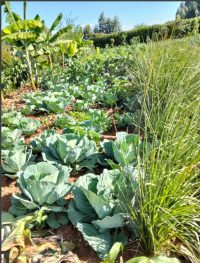 Imagine your vegetable garden producing much more food, staying cooler even in extreme heat, and never needing expensive compost again—all from one small investment that lasts decades. This special plant, vetiver (it’s sterile and won’t spread!) creates a living fence around your garden that blocks wind, gives beneficial insects a home to protect your crops, and provides endless free mulch.
The hidden secret is what happens beneath the surface: improved soil moisture (water infiltrates better and stays longer), enhanced plant nutrients (beneficial microbes in vetiver roots help vegetables absorb nutrients), and pest control above and below ground (beneficial insects protect leaves while roots suppress harmful nematodes). Plus, abundant mulch from regular cutting minimizes weeding—saving hours of backbreaking work. more
Retrofitting Stone Terraces
Stone terraces represent significant infrastructure investment that can be dramatically enhanced through vetiver integration. While stone terraces effectively reduce slope and prevent soil movement, they have inherent vulnerabilities: gaps between stones allow fine soil particles to wash through, stone structures can settle or collapse over time without root reinforcement, and bare soil between terraces remains exposed to erosive forces.
By retrofitting existing terraces with vetiver hedges, you create a synergistic system where stone provides immediate structural support while vetiver roots (penetrating 3-4 meters deep) bind soil, filter runoff, trap sediment, and stabilize the terrace foundation itself. Plant vetiver hedges along the contour immediately above each stone terrace line, positioning them 30-50 cm up-slope from the stone face, using slips spaced 10-15 cm apart. A non profit group working on Rodriguez Island (Mauritius) is doing this 0n an island where in the 1960s vetiver hedgerows were quite widely planted with success, but then forgotten!
Stabilizing Farm Irrigation Channels
The technique transforms earthen channels from constantly degrading infrastructure requiring continuous maintenance into permanent, self-maintaining systems. The dense vetiver canopy creates a ‘roofed’ effect that eliminates all weed growth while vertical root walls hold banks stable indefinitely.
Establishment costs $68-99 per 100 meters (single row configuration) with payback in 14-36 months through eliminated maintenance, then virtually zero ongoing costs compared to $58-209 annually for conventional clearing, herbicides, and repairs. This is infrastructure bio-engineering already working at commercial scale in Zimbabwe’s Hippo Valley sugar estates and Madagascar’s smallholder irrigation programs. Some are already in use, others part so. All are based on farmer feedback, experiments and solid biological science.
Six Vetiver System Based Farm Models
Analysis and feed back from users suggest that there are six basic vetiver applications that could be embedded into farm systems that can address both water management, soil conservation, and the five hidden benefits noted is proceeding section of this newsletter. They are briefly summarized below. By the next newsletter we hope to shares 2 page fact sheets and a detailed farmer guide for each. These models (that are scalable) should have global application
V101 – Foundation System
The simplest and most proven vetiver configuration, establishing permanent contour hedgerows at 2-meter vertical intervals with 3,500 plants per hectare. Provides excellent water management, erosion control, and zone-enhanced benefits within 1-2 meters of hedges, suitable for any farmer on any slope with minimal complexity.
V101-E – Enhanced Mycorrhiza Coverage System
Builds on V101’s permanent hedgerows by adding individual standalone vetiver plants in a 4-6 meter grid pattern between hedges, totaling 4,125-4,550 plants per hectare. Delivers complete field-wide mycorrhiza coverage, putting every crop within reach of the 10-15 meter mycorrhiza networks for enhanced nutrient uptake, drought resilience, and 60-75% nematode suppression across the entire farm.
V48 – Intensive Hedgerow System
Dense permanent contour hedgerows at 4-8 meter horizontal spacing with 7,500-15,000 plants per hectare, delivering the optimal balance between performance and management complexity. Provides field-wide nematode control (70-90%), meaningful temperature reduction (1-3°C), substantial mulch production, and serves as the ideal foundation for agroforestry integration.
VCR – Rotation Transformation System
Combines permanent V101 hedgerows with intensive rotational vetiver planted at 1-meter spacing in one-quarter of the farm at a time, rotating through all sections over 12 years with 11,750 total plants per hectare. Delivers maximum soil transformation through massive organic matter input (83-130 tons per 3-year cycle), complete nematode elimination (90-95%), and significant temperature reduction, ideal for severely degraded soils and ASAL livestock operations.
VFF – Food Forest (Perennial Integration System)
Establishes vetiver as the permanent ground layer within multi-story agro-forestry systems using 25,000-30,000 plants per hectare initially, creating near-continuous ground cover with billions of deep root channels throughout the soil profile. Delivers documented Vanya-level performance including 7-10°C temperature reduction, massive carbon sequestration (71 tons CO₂/ha), and exceptional drought resilience, with vetiver naturally thinning 40-60% over 15-20 years as tree canopy matures.
VPGS – Plantation Grid System
Designed specifically for existing perennial plantations (coffee, tea, citrus, avocado) where standard contour hedgerows cannot be retrofitted without destroying crops. Uses permanent infrastructure hedgerows with short water diversion spurs if off the contour, overlaid with a 6m × 6m grid pattern of individual plants (6,000-9,000 plants/ha) positioned between existing crop rows, delivering complete mycorrhiza coverage and field-wide nematode control without requiring contour-based layout.
Success Stories from the Field
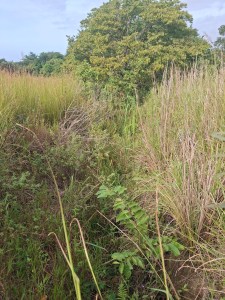
Darryl De Lange (South Africa) reports: “Three years ago this was a 2.5m eroded gully with bare walls and continually eroding. Just planting vetiver either side slowed the water down enough to allow for natural vegetation to take hold with zero erosion anymore.”
Chris Wong from dragon fruit farming: “I’m going to add 1-2 vetiver to each dragon fruit from now on. Dragon fruit, grapes, and passion fruit share shallow fleshy roots, vining habit, very high nematode susceptibility, root rot complex vulnerability, extreme temperature sensitivity, the drainage paradox, and short productive lifespan. Vetiver addresses all seven constraints simultaneously.”
Ethiopia’s water impact: Seasonal springs converted to perennial flow after vetiver was established on degraded upland catchments. Wells became more reliable within two growing seasons. A degraded wetland in Illubabor Province held water year-round for the first time after vetiver was planted across 1,018 hectares of its contributing watershed—biodiversity recovery followed within the same season.
Fiji’s long-term demonstration: Thirty years of vetiver hedgerows on unterraced 20% slopes have raised gully floors to surrounding landscape level through biological sediment deposition alone, without a single check dam, gabion, or engineered water harvesting structure. In St Vincent and the Grenadines Vonnie Roudette is rehabilitating 80 year old vetiver created terraces – who said that vetiver has no longevity?
Field Notes from Somo Abdul Kabir – Marsabit, Kenya
(Somo is a businessman and farmer who is leading the way in developing on farm vetiver for this arid and hot part of the country)
On Establishment Best Practices
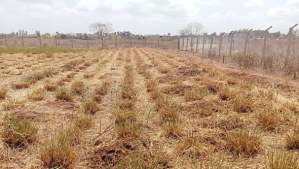 Based on my experience establishing vetiver in Marsabit (<500mm annual rainfall), I’ve found that 10cm spacing produces faster hedgerow interlocking than 15cm spacing. While both work, the tighter spacing establishes proper dense hedges more quickly—an important consideration in our unpredictable climate.
On Pricing and Accessibility
Current slip prices reflect limited supply, but we expect costs to drop as 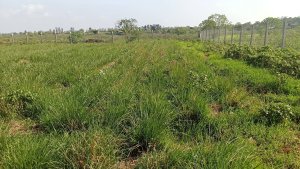 more farmers establish nurseries and join the network. I always tell potential clients: better to invest now than regret it later when you see your neighbors succeeding.
For farmers struggling with initial investment, there’s a patient path forward: Start with 100 slips, establish a nursery, and wait 8-9 months for
multiplication before the next rainy season. That initial 100 becomes approximately 5,000 slips (100 × 50 tillers per plant). We’re now seeing this play out with young farmers whose parents received just 5-10 slips from our farm in 2023—those small starts have now multiplied substantially.
On System Selection for Marsabit Conditions
VCR is challenging here because our rain patterns are highly unpredictable. I prefer V48 for our conditions—once established, it solves the perennial problems we experience: drought periods, feed scarcity, and soil degradation. I’m planning to experiment with making silage from vetiver to address feed shortages during our extended drought periods.
On Policy and Adoption
We hope government and policymakers will eventually adopt what we’re demonstrating on the farm. For now, we’ve gained an entry point through non-governmental organizations, which is progress. Vetiver is much easier than conventional solutions, but it requires patience—which is currently lacking among many farmers. Our vision is to see vetiver as widespread here as it is in India and the Philippines. We’re just starting.
On Recent Outreach and Nursery Expansion
Recent farmer meeting didn’t go as planned—only three participants showed up—but I’ve advised them to start small nurseries using 100 slips from clumps planted in 2023. By year’s end, they’ll have enough slips to plant an acre, then duplicate and spread the word to neighbors and family members.
On Current Growing Conditions
I’m preparing to expand our nursery this weekend. Tomorrow I’ll prepare the dip treatment for Saturday planting, and I’ll track and share the results. I stopped cutting the hedges almost a month before the rains arrived to maximize root energy.
Our climate pattern: We typically have two rainy seasons—October-November (which was minimal last year, arriving in December for just one week) and March-April (which looks promising this year with prolonged showers for three weeks and some flooding that will help slips retain moisture). The challenge is our extended dry season: June to November or even December—almost 5-6 months without rain. This long waiting period between rain seasons makes establishment timing and slip survival critical.
Field Notes from Peter Kingori – Kiambu County, Kenya
Peter works with Trees For the Future and was responsible for introducing vetiver into TFFs agro-forestry programs. He and Nancy Wambui have set up a charity called ” Reclaim Our Soils with Vetiver”. (Reclaim)
New Agroforestry Program Launch
Mother Trees has just developed a concept paper titled “Restoring Opportunities through On-farm Trees System.” The concept gives vetiver a prominent place supporting an agroforestry system that will train and support farmers in adoption. Over the next five years, we plan to work with 6,000 farmers and restore 4,000 hectares across three areas in Kiambu County: Ndeiya, Nachu, and Karai (Karai and Nachu are in Kikuyu subcounty; Ndeiya is in Limuru subcounty). We intend to use remote sensing to capture landscape details, tree cover, and monitor change as we plant living fences, woodlots (trees and fruits), alleys, and vetiver hedgerows.
On Demonstration and Farmer Adoption
This technology is doable, but we need an entry point to create confidence among farmers. The implementer needs to secure a demonstration site—either through leasing or with a willing farmer, ideally someone practicing commercial orchards.
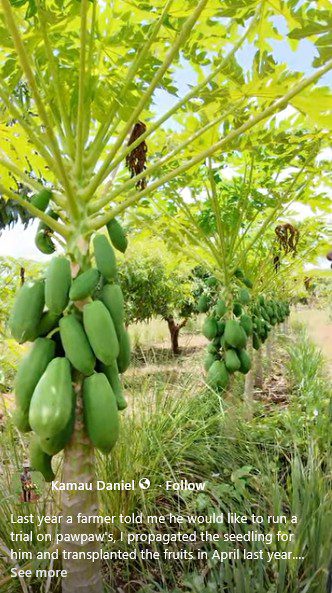
One thing I know about our people: if a technology is demonstrated and it works, they will definitely take it up—but they don’t want to be the first ones. Once it works, they will surely adopt it. Farmer Daniel Kamau has already embraced vetiver application very well. Though not closely spaced, he has introduced several hedgerows, and we’re taking farmer leaders to learn from his example. Daniel’s farm impressed Paul Zuckerman (TVNI Director) tremendously. Daniel is a big promoter of regenerative agriculture and exactly the kind of advocate we need.
On Spacing and Design Innovations
For the proposed vetiver farm models different spacings should be trialed for VCR model—1m, 1.5m, and 2m—to accommodate at least two rows of crops between hedges. The 1m spacing looks small for our farming systems.
I’ve also been exploring vetiver cuvettes (living grass basins) around individual trees rather than continuous hedgerows. We’ve introduced cuvettes with Daniel around one avocado in a plot measuring about 20m × 20m (he has five avocados in that portion). We’ve also established five vetiver rows. The vetiver cuvette has more functions than a cuvette made by earthing up soil—it provides the water-trapping function plus all vetiver’s additional benefits.
For tree plantations, we could plant vetiver in strategic clusters around each tree rather than continuous 15cm-spaced rows—a bigger population of clumps where each tree or plant is located.
On Banana-Nematode Challenge
Nematodes are one of the major challenges facing bananas in Ndeiya, Karai, and Nachu. This is an area where we can strongly encourage farmers to adopt vetiver. The concern about vetiver being suppressed by banana shade can be avoided in small-scale production where farmers plant bananas in rows rather than as dense estates—this allows vetiver full access to sunlight between rows.
On Nursery and Distribution Strategy
Given that Ndeiya, Karai, and Nachu are semi-arid, our approach will be to:
- Grow vetiver clumps in a bulk nursery
- Give farmers a few slips for their own multiplication
- Establish farmer-based demo plots where other farmers can learn
This builds both supply and knowledge transfer simultaneously.
On Standards and Quality Control
Peter has reviewed the V48 guidelines—they provide excellent, applicable bare minimum standards. These standards are what all practitioners and community trainers should adhere to. Standards add value to a product. These will benefit Reclaim hugely once we start working with Mother Trees and Paul.
I appreciate the strictness being implemented so we have a cohesive system that research can validate. Practitioners can still be innovative while working within communicated standards—this combination of rigor and flexibility is essential. TVNI Design Standards
Next Steps
The Mother Trees-Paul partnership will give us a window to work holistically with vetiver and promote it at large scale. This alignment with papaya-vetiver research and Daniel’s demonstration farm creates the perfect foundation for scaling regenerative agriculture practices across Kiambu County. Some of Kenya’s smallest farms are in Kiambu county – and like their Vietnamese counterparts they know hoe to farm.
Getting Started: Critical Success Factors
When ordering vetiver planting slips, you should receive well-packed, damp, live slips with 3 tillers each. With proper care, each slip becomes 150-200 tillers within 18 months. Success rates reach 95-98% when you follow two critical steps:
- DIP TREATMENT Mandatory Dip Treatment: Mix 1 bucket of aged compost with 20 liters water, 2-3 handfuls of healthy soil (from near vetiver or termite mounds is best + a cup of molasses). Let it sit covered for 24 hours before planting day so beneficial microbes can multiply. Dip vetiver roots in this mixture for 15-30 minutes just before planting. This single step can cut mortality from 50% to 2%. amd improves early growth rate significantly – particularly in dry areas with difficult soils. The dip also accelerates the development of AMF microbials that really benefit vetiver and associated crops. more
- WEEKLY WEEDING for first 8 weeks: Weed competition kills more slips than drought or pests combined.
Keep slips damp until planting, plant crown 5cm below soil surface, water daily for 2 weeks then reduce gradually. The effort you invest in the first 8 weeks determines whether you get thriving vetiver or dead sticks—there’s no middle ground.
Connecting Farmers and Science: The Path Forward
These stories from Vietnam, Ethiopia, Brazil, and around the world reveal a critical gap in agricultural knowledge transfer. Valuable research sits in journals while farmers independently rediscover the same phenomena in their fields, often attributing results to incorrect mechanisms.
When farmer-science collaboration works well, it can be transformative—farmers provide real-world observations and context, while scientists offer mechanistic explanations and optimization strategies. Both perspectives are essential.
For farmers worldwide vetiver should not be merely an erosion control tool, but as a multi-functional agricultural infrastructure activating at least five hidden biological services—nematode suppression, pest trapping, beneficial insect habitat, mycorrhiza networks, and deep water management.
Strategic placement around nematode-susceptible crops, along field margins, and within 15 meters of crops needing enhanced nutrition and water maximizes these synergistic benefits. Farmers should expand the documentation of what they observe—these field discoveries matter, even when the full explanation is not yet known. They provide great opportunities for the practical involvement of the scientific community.
The hidden benefits are there. The science is proven. The water is still falling. Now it’s time to act.
36 acres in Arizona. Try https://www.drylandsfarmingcompany.com/ California vetiver supplier. Vetiver grew quite well at Victorville, CA. Hibernates during winter.
None as yet
I have 36 acres of high desert in Arizona zone 7.
Would like to obtain 100 slips to start a nursery and plant out before rains in August.
Do you know of a source near me I could order from?