(updated August 26, 2026)
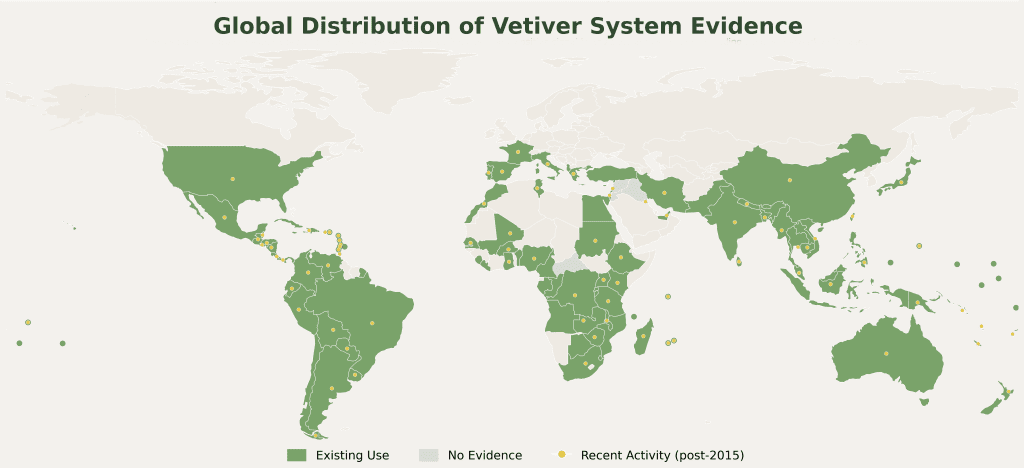
This package is a suite of generic design standards and guides for Vetiver Grass Technology, grounded in research, long-term field experience and, where applicable, current engineering practice. It exists because the global spread of VGT created a need for consistency. The standards give practitioners design and implementation guidance, help agencies, consultants and contractors prepare contract-ready documentation, and set minimum technical requirements for design, plant material, installation and quality assurance.
They are deliberately generic. VGT is a nature-based technology, and local soils, climate, hydrology, effluent characteristics and regulation all shape how it performs. Adapt them to your site, your regulatory framework and your project objectives. Do not apply them rigidly.
Every module contains a table of contents and a reference list supporting its design logic. Links point to Google Drive; internal table-of-contents links work only once the file is downloaded.
Start here
|
Vetiver Hedge Mechanisms (v3.1 -new)— above ground, below ground, structural, operational and solute roles. The physical and biological basis for everything else in the package: how a hedge slows water, spreads it, builds terraces, reinforces soil and moves nutrients. Read this before choosing a module. Vetiver and Water: Hydrology, Hydraulics, and the Hidden Benefits (v1.0-new) Where Vetiver Hedge Mechanisms sets out the parts of the hedge, this one isolates the single function that underlies most of them and is the one most often misread — the management of water. It is written to be read before the application modules (A–D), because in almost every one of them the first and most important design decision is what you intend water to do. Hedge or Stand-alone (new) is a decision guide — five planting forms, when and why to use each, and the six mistakes that recur everywhere. This “quick” guide supplements the matrices below Vetiver Planting Guide (revised)— planting instructions covering nearly all applications. Plant material, root and shoot trim, crown depth, spacing, firming and gap-filling. |
Background reading — the science behind the standards
|
Vetiver Roots: The Vetiver System Technology Hidden Half — Dr. Paul Truong, The Vetiver Network International, 2022, 173 pp. Paul Truong has done more than anyone to put the Vetiver System on a measured footing, and this book is where the belowground half of that work is gathered. It is not a design standard and does not tell you what to build. It tells you why the standards say what they say. It covers root growth, distribution and lifespan; root responses to flooding, drought, salinity, aluminium toxicity and heavy metals; penetration of compacted and mechanically resistant soils; interactions with soil organisms including mycorrhizal fungi; and the principles of slope stabilisation, with their limits stated. It is also extensively photographed — root excavations, roots driven through compacted dam walls, shaded against open-grown plants, root systems at depth — a visual record of the hidden half that exists nowhere else and is worth the download on its own. A concrete measure of its value rather than a compliment: reading it systematically produced version 2 of the Mechanisms standard, which withdrew an apparent root cohesion figure the manual had carried since its first revision, corrected two statements, and added five new items to its register of open questions. Very few reference works earn their keep that visibly. |
Choosing a module
Modules are grouped in four domains — A water and hydrological protection, B slopes, earthworks and geotechnical stability, C wastewater, effluent and pollution control, D livelihoods, products and community systems. Work from the problem, not the domain:
| Your problem | Start at |
|---|---|
| Canal, river or stream bank erosion | A1, A2 |
| Gully head-cutting and channel loss | A6 |
| Reservoir or dam draw-down zone, fluctuating water level | A3, A4 |
| Farm-scale soil and water loss | A5, D3, D12 |
| Shallow slope or embankment failure | B1, B2, B3 |
| Engineered slopes (steep, difficult, high risk) | B1 |
| Failed or reactivating slope (landslip) | B2 |
| Slopes and construction on Vertisols (black cotton soils) | B5, D12 |
| High-strength wastewater — coffee, POME, landfill leachate | C1, C4, C5 |
| Raw sewage | C2 |
| Polishing treated effluent to a compliance standard | C3 |
| Urban stormwater at plot scale | C6 |
| Lake, tank or reservoir pollution | A8 |
| Community income and adoption | D1, D2, D9, D13. D15 |
| Soil biology, pests, nematodes, forage | D4–D8 |
| Soil Carbon, soil health | D14, D12, D5 |
| Planting technique | D4, D16 |
Many sites need more than one module. Common pairings: B1 + C5 for landfills; B1 + C2 for sewage lagoons; A6 + A5 for degraded catchments; A3 + A4 for hydropower reservoirs; any C module + D1 for community-run systems.
Data to gather before you design
| Hydrology | Geotechnical | Effluent (C modules) | Site constraints |
| Rainfall intensity and seasonality; runoff patterns; water-level fluctuation (A3, A4); effluent volumes and loading rates | Slope gradient and height; soil type and shear strength; seep lines or perched water; stability history | COD and BOD; ammonia, nitrate, phosphate; pH, EC, salinity; oil and grease (POME) | Available land; access for planting and maintenance; regulatory offsets from gas lines, geomembranes and similar |
What VGT can and cannot do
VGT can
- Increase near-surface shear strength and reduce shallow slip risk
- Increase infiltration in the hedge zone and reduce runoff volume and velocity
- Reduce pore-water pressure in the rooted layer
- Trap sediment and build terraces
- Treat wastewater through evapotranspiration and nutrient uptake
- Survive nearly indefinitely anaerobic conditions so long as not totally submerged and receives a transition period
- Stabilize slopes, banks, embankments and gully works
- Supply forage, mulch, improve soil structure and health, thatch and craft material, and support rural enterprise
VGT cannot
- Replace structural reinforcement where deep-seated failure is likely
- Treat effluent beyond the biological capacity of the system without pre-treatment
- Grow in deep shade (stops growing at 80% shade)
- Tolerate glyphosate
Common causes of failure
Across global experience, failures come from a short and repetitive list. Each module’s design envelope carries its own risk notes; these are the ones that recur everywhere.
-
-
- Glyphosate drift. It kills vetiver outright. Keep a 2 m no-spray corridor and settle this at design stage, not in year two. Decisive where VGT is proposed alongside herbicide-based conservation tillage.
-
- Shade. Deep shade suppresses growth severely. Note that shading an already-established hedge is more damaging than establishing under shade, so agroforestry and orchard designs must consider canopy closure years ahead.
-
- Abrupt transfer into saturated ground. Vetiver does grow in waterlogged anaerobic soil, but it takes roughly three weeks to build the aerenchyma that oxygenates its roots there. Dryland-raised material set straight into standing anaerobic mud is at risk through that window. Stage the transition, or use material already raised wet. This is an establishment constraint, not a species limit — and it is the likeliest origin of the belief that vetiver cannot take waterlogging.
-
- Incorrect spacing, density or alignment. Off-contour alignment destroys the spreading function, which is the mechanism most field results depend on.
-
- Poor maintenance in the first 8–12 weeks. Includes livestock access before the hedge is established, and cultivation too close to the line.
-
- Overloading evapotranspiration or treatment systems. Loading beyond design capacity.
-
- Planting on active landslide zones. Drainage control comes first.
- Ignoring hydrological pathways. Especially seep lines.
The Modules
Note: The fifth column will link each module to a matching specification sheet — problem definition, performance objectives, design criteria, layout, materials, installation sequence, operation and maintenance, failure modes and monitoring indicators, with numeric fields left open. This turns each standard into something a client can put into a proposal and a contractor can bid against. It is the step that makes the package commercially usable, and it directly supports the policy argument above. The current modules are in the process of revision. Check the dates and version number.
A — Water and hydrological protection
| Code | Version/date | Module | What it addresses | Specs Sheet |
|---|---|---|---|---|
| A1 | v1 - 01/15/2026 | Canal Bank Stabilization | Stabilizes canal embankments; reduces erosion and desilting | |
| A2 | v1 - 01/15/2026 | River and Stream bank Buffer System Specifications | Protects riverbanks; filters sediment from riparian inflow | v1 - 01/18/26 |
| A3 | v1 - 01/15/2026 | Draw-down Zones and Fluctuating Water-Level Systems of Dams and Reservoirs | Stabilizes fluctuating margins; resists wave action; tolerates periodic submergence | v1 - 01/18/26 |
| A4 | v2.1 - 08/13/2026 | Vetiver Floating Islands | Nutrient removal in open water; reduces algal blooms | |
| A5 | v1.1 - 08/22/2026 | Farm Soil and Water Conservation | Conserves soil and water; increases infiltration; reduces runoff | v2 - 8/26/26 |
| A6 | v1 - 01/15/2026 | Gully Rehabilitation | Arrests head-cutting; stabilizes sidewalls; reduces sediment export | v1 - 01/18/26 |
| A7 | v1- 03/01/2026 | Flower Industry — water quality, compliance and environmental resilience | Kenya case study; effluent and compliance framework for cut-flower operations | |
| A8 | v1- 03/12/2026 | Lake, Tank and Reservoir Pollution | Integrated approach to pollution in standing water bodies | |
| A9 | v1 - 04/09/2026 | Retrofitting Watershed infrastructure on a regional basi | ||
| A10 | Wind Erosion Control & Sand Movement Managemen | v1 - 1/18/26 | ||
| A11 | Hillside Springs, Seeps & Small Catchment Source Protection | v1-01/18/26 | ||
| A12 | Gully Floor Rehabilitation | v1 - 01/18/26 |
B — Slopes, earthworks and geotechnical stability
| Code | Version/date | Module | What it addresses | Specs Sheet |
|---|---|---|---|---|
| B1 | v4 - 8/26/26 | VGT for Engineered Slopes. An integrated bio-hydro-mechanical stabilization system | Combines vetiver with geofabrics; pore-pressure reduction | v1 - 8/26/26 |
| B2 | v1 - 01/14/26 | Landslide Repair | Stabilizes failed slopes; improves drainage; reduces reactivation risk | v1 - 1/18/26 |
| B3 | v1 - 01/14/26 | Specifications for slope stabilization | Strengthens embankments and berms; reduces seepage – simple and complex slopes | v1 - 1/18/26 |
| B5 | v1 - 03/01/26 | Civil, Hydraulic and Geotechnical Applications on Vertisols | Design for cracking clays, where behavior differs sharply from other soils | |
| B6 | Ist edition 01/01/26 | Standard Specification for SlopeGrass Stabilization Using Vetiver | Book by Dr. Mohammad Shariful Islam | |
| B7 | Soil Traps and Silt Fences | reduce sediment losd to road drains. | v1 - 1/18/26 | |
| Firebreaks & Post fire slope recovery | slope stabilization with quick recovery | v1 - 1/18/26 |
C — Wastewater, effluent and pollution control
| Code | Version/date | Module | What it addresses | Specs Sheet |
|---|---|---|---|---|
| C1 | v1 - 01/14/26 | Constructed Vetiver Wetlands for Coffee Processing Effluent | High-organic wastewater; reduces BOD and COD; neutralizes acidity | |
| C2 | v1 - 01/16/26 | Raw Sewage Treatment | Pathogen and nutrient reduction; improves discharge quality | v1 - 1/18/26 |
| C3 | v1 - 01/19/26 | Tertiary Treatment of Residential and Industrial Wastewater | Polishing to compliance standards; removes residual solids | v1 - 1/18/26 |
| C4 | v1 - 01/16/26 | Oil Palm Mill Effluent (POME) Treatment | Extreme organic load; oil removal; clarity | |
| C5 | v1 - 01/17/26 | Landfill Effluent (Leachate) Treatment | Toxic leachate; heavy-metal uptake; ammonia reduction | v1 - 1/18/26 |
| C6 | v1 - 02/28/26 | Vetiver Rain Garden Design and Implementation Manual | Urban and plot-scale stormwater management | |
| C6 | Landfill & Dumpsite Stabilization | Cover Integrity, Erosion Control & Leachate Pathway Management) | v1 - 1/18/26 | |
| C7 | Urban Green Infrastructure (UGI) & Roadside Green Corridor | Noise Berms, Medians, Embankments, Micro-Parks & Linear Green Systems | v1 - 1/18/26 |
D — Livelihoods, products and community systems
| Code | Version/date | Module | What it addresses | Specs sheet |
|---|---|---|---|---|
| D1 | v1 - 01/15/26 | Handicrafts | Vetiver-based craft production; rural enterprise; income for women’s groups | |
| D2 | v1 - 01/19/26 | Integrated Vetiver Oil and Slip Production | Oil plus planting material; value chains; supply reliability | v1 - 8/24/26 |
| D3 | v1.1 - 8/22/26 | Farm Soil and Water Conservation | Conserves soil and water; increases infiltration; reduces runoff and erosion | v2 - 8/26/26 |
| D4 | v3 - 7/22/26 | Microbial Root Dips for Vetiver Establishment | Farm-made inoculant to improve establishment and root regeneration | |
| D5 | v3 - 7/22/26 | Vetiver and Arbuscular Mycorrhizal Fungi — soil health, water and nutrient transfer | Shared mycorrhizal root zone between hedge and crop | |
| D6 | v3 - 7/22/26 | Nematode Suppression and Soil Biological Recovery | Vetiver as a dead-end trap for nematodes in fields and agroforestry | v1-2/6/26 |
| D7 | v3 - 7/22/26 | Dead-End Trap Plant for Cereal Stem Borers | Stem borer management in maize, sorghum and rice; hedge design; parasitoid support | |
| D8 | v2 - 7/26/26 | Forage Management of Vetiver Grass | Cutting regimes for forage yield, quality and drought reserve | |
| D9 | v2 - 6/11/26 | Kitchen Gardens - Vetiver based | With fact sheet -Swahili | |
| D10 | v1.1 7/26/26 | Chrysopogon nigritanus (African black vetiver) compared with C. zizanioides (Asian vetiver) | Species choice; D10a adds Napier (Pennisetum purpureum) as a third comparison | |
| D11 | v1.1 - 08/16/26 | Vetiver Floating Islands and Tilapia Farming v1.1 (revised) | Combined water quality and aquaculture production | |
| D12 | v2 - 8/18/26 | Agriculture, Soil Health and Water Management on Vertisols | Farm-scale companion to B5 | |
| D13 | v1 - 6/11/26 | Vetiver Farm Model Package | Seven model applications with start guides, fact sheets and support files | |
| D14 | v2 - 7-26-26 | Vetiver and Soil Carbon | What can and cannot be claimed for soil carbon accumulation under vetiver | |
| D15 | v1 - 8/14/26 | Vetiver Mulch Versus Veticompost | keep compost for high value crops and veges. Vetiver mulch for field crops | |
| D16 | v2.1 - 8/02/26 | Vetiver Planting Guide | planting instructions covering nearly all applications. Plant material, root and shoot trim, crown depth, spacing, firming and gap-filling. |
Keeping the package current
These standards will keep developing, because VGT is a living technology and innovation, field learning and practitioner experience remain essential to it. TVNI welcomes feedback, case studies, corrections and technical contributions. Where errors are identified, modules are revised and the package is reissued; new modules are added as they are completed. Contradicting field evidence is as welcome as corroborating evidence, and more useful.
| Disclaimer. These standards are provided as guidance only. TVNI does not assume responsibility for project outcomes. The performance and results of any vetiver application depend on the decisions, designs, supervision, and workmanship of those who plan, specify, and implement the work. |