Our February Newsletter is coming out quite late for technical reasons: we have just migrated the TVNI website from its long time host, CSS Communications (of Bellingham, Washington) to a new host and so were “down” during the transfer. As we migrate to the new hosting provider, we wish to extend our deepest gratitude to Ray Poorman for his extraordinary generosity and steadfast support of The Vetiver Network International. Ray has, for almost 30 years, generously provided free hosting and technical support for www.vetiver.org since its inception in 1997. His support helped to provide the digital foundation for our global knowledge network and contributed materially to the Vetiver System’s worldwide reach. In recognition of his unfailing friendship, TVNI wishes to honor Ray’s contributions and long-standing commitment to our mission. Ray, your support has been a true boon to TVNI, and we are deeply grateful.
GLOBAL WATER BANKRUPTCY: A new UN report on the “new normal” for water
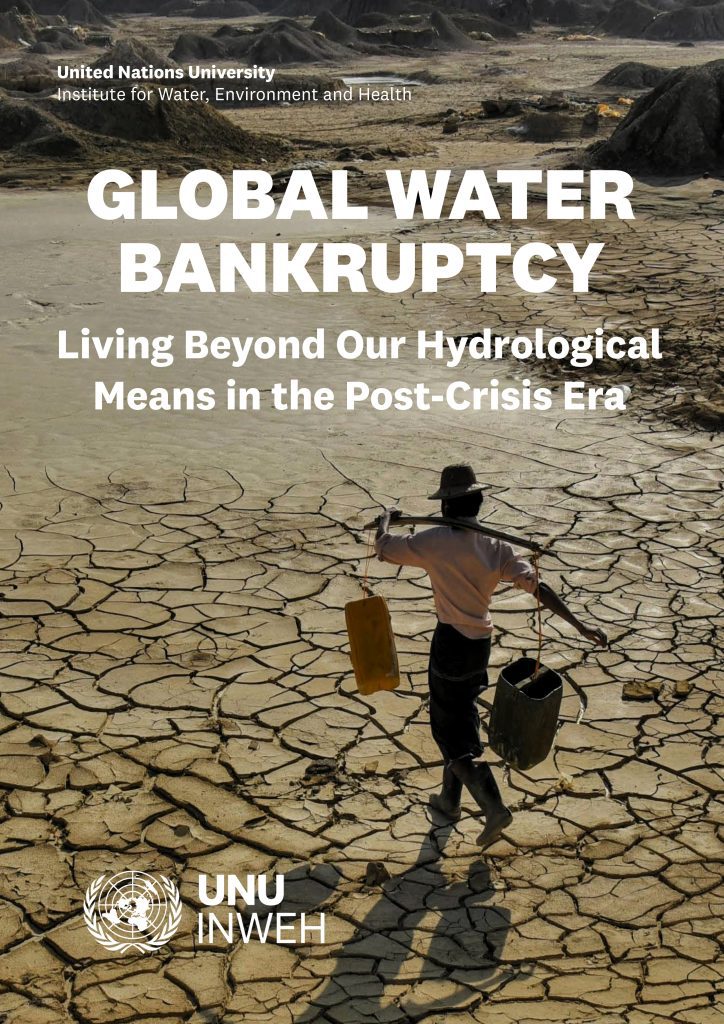 A new UNU-INWEH report argues that we have moved beyond a recurring “water crisis” into an era of Global Water Bankruptcy: many basins have overdrawn both annual water “income” and long-term “savings” (aquifers, soils, wetlands, glaciers) to the point that recovery to past baselines is no longer realistic.
The evidence is sobering. Around 2.2 billion people still lack safely managed drinking water, 3.5 billion lack safely managed sanitation, and ~4 billion face severe water scarcity at least one month per year. Meanwhile, surface waters are shrinking, wetlands have been “liquidated” at continental scale (~410 million hectares lost; ecosystem services valued >US$5.1 trillion), and groundwater – now ~50% of domestic supply and >40% of irrigation – continues to decline in ~70% of major aquifers, with land subsidence already affecting millions of km².
The report’s message is blunt: stop assuming we can “return to normal.” Instead, we need to move into “bankruptcy management”, which means honestly diagnosing insolvency and irreversibility, putting hard limits on irreversible damage (over-pumping, wetland/riparian loss, pollution), rebalancing rights and expectations within the existing, degraded carrying capacity, and protecting vulnerable groups to ensure that they whatever transitions are necessary, that they are just and protect their rights and access to needed water resources.
TVNI readers will recognize this framing from recent posts that focus on repairing the hydrologic cycle at field and watershed scale – especially the Newsletter pieces on the “Broken Hydrological Cycle” (infiltration, runoff, slope stability) and “A Changing Perspective” (runoff and soil-loss reductions, drought buffering), and Bhadsavle et al. recent study (“Measurement of Rainwater Infiltration Capacity of Vetiver Grass Using 1.8 m Plastic Circular Column”) that added fresh quantitative evidence: over 230 rainy days, a soil column upon which vetiver was planted was able to infiltrate/percolate ~1,467 L of rainfall vs only ~465 L (about 70% less) of rainfall from a similar column with bare soil, From the vetiver-treated column, no runoff or soil loss were observed.
How VGT fits — a call to action for TVNI members
Wherever opportunity arise, TVNI members should use the “Global Water Bankruptcy” framing to put Vetiver Grass Technology (VGT) in front of decision-makers, not as a niche conservation tool, but as a practical, field-ready measure for restoring hydrological function and reducing avoidable losses. In your country dialogues, insist that VGT is explicitly considered wherever relevant, including: (1) erosion control and slope stability on farms, roads, canals, and construction sites; (2) reducing runoff and improving infiltration in degraded catchments and peri-urban landscapes; (3) protecting and rehabilitating riparian buffers and wetlands through sediment and bank-stabilization; (4) improving water quality by trapping sediment/nutrients and integrating vetiver into nature-based treatment for wastewater/effluent; (5) drought resilience for smallholders via better soil moisture retention and reduced topsoil loss; and (6) climate adaptation projects needing low-cost, locally maintainable interventions.
Consider putting together a one-page VGT option note to share with your local and national water/land agencies, watershed committees, NGOs, and donors, and ask: “Where in your plans can VGT be deployed this year?”
From Science to Global Leadership – Patricia Tello Reátegui, Peru
TVNI is pleased to highlight the work of Patricia Tello Reátegui, TVNI Coordinator for Peru and an environmental management specialist whose career has consistently focused on practical, field-tested approaches to sustainability—reducing the carbon footprint of development projects while advancing renewable and nature-based solutions. In Peru’s coffee sector, Patricia and her team have successfully implemented the Vetiver System to treat coffee-processing wastewater, providing small producers with a low-cost, low-maintenance alternative to conventional sedimentation pits. After three years of research, this vetiver-based infiltration approach was validated by the Rainforest Alliance, underscoring its effectiveness and replicability. The article below, which was contributed by Yorleny Cruz, shares Patricia’s broader journey—from applied research to international recognition—and why her leadership and results matter for vetiver practitioners across the TVNI network.
In September 2024, Patricia Tello Reátegui traveled to the United States as a Fellow in the USDA Scientific Exchange Program. During her training at Florida A&M University, she strengthened her skills in designing and validating bioremediation and phytoremediation systems, advanced water-quality monitoring, and environmental modeling applied to agricultural systems.
What began as an international academic experience quickly became a catalyst for territorial transformation.
Upon returning to Peru in December 2024, Patricia—an Engineer in Renewable Natural Resources, a regenerative agriculture specialist, and Founder of Biorremedia Vetiver Perú—began implementing and scaling nature-based solutions for agricultural and agro-industrial systems.
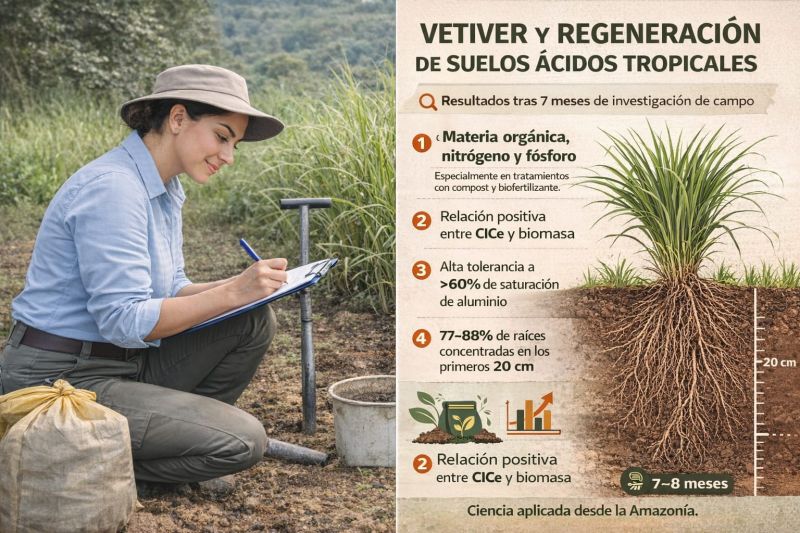
During 2025, her work achieved notable results, including:
- Estimated reductions of up to 60% in BOD₅ (biochemical oxygen demand) in agricultural effluents.
- Integration of plant biomass into regenerative approaches that strengthen soils and reduce reliance on chemical inputs.
- Adaptation of floating and hydroponic treatment systems for agro-industrial lagoons.
- Isolation and cultivation of specific microorganisms tailored to the type of water being treated.
- Direct impact on more than 400 producers, with strong participation by women.
- New scientific research currently under international review.
These solutions demonstrate that restoring soils, improving water quality, and reducing pollutant loads in production systems are not only environmental actions—they are practical strategies for strengthening sustainable productivity, climate resilience, and the stability of agri-food value chains.
Food security begins in the soil. Without healthy soils, clean water, and resilient systems, sustainable production is not possible. Patricia’s approach integrates soil restoration, natural effluent treatment, reduced dependence on external inputs, and strengthened local capacity—directly contributing to more sustainable and climate-smart food systems.
Then came international recognition.
In December 2025, Patricia received official notice from the Netherlands that her name was being considered for the World Agriculture Forum (WAF) Council, a global platform helping shape the world’s agricultural agenda. In early 2026, her appointment was approved, and she now serves on the WAF Global Council—an international space where policy, innovation, trade, and agricultural sustainability are advanced at the global level.
Her inclusion represents: stronger food security rooted in soil and water stewardship; increased visibility for nature-based solutions—including vetiver- and microbiology-based technologies—as strategic tools for sustainable agri-food systems; a stronger Latin American presence in global agricultural governance; and the leadership of a woman scientist with deep field experience in a decision-shaping global forum.
Earthshot Network — Potential Funding Opportunities for Vetiver Practitioners
TVNI is sharing an “opportunity alert” circulated to the Earthshot Prize nominee community. We receive these because the Vetiver System has three nominations for the 2026 Earthshot Prize. Several current calls are a good fit for our network members that are working with VS for climate resilience, restoration, water security, and inclusive enterprises (e.g., women-led vetiver nurseries to meet local demand for planting material; a service enterprise installing vetiver hedgerows for erosion control with trained local crews and profit-sharing; a co-op or self-help group producing vetiver-based products (mulch, crafts, essential oil) with equitable and transparent benefit distribution.
These opportunities span investment, leadership development, monitoring tools, and challenge grants. Members working on erosion control, slope/riverbank stabilization, mine rehabilitation, green infrastructure, and regenerative agriculture may find some of these relevant to their work, especially where you can show measurable outcomes, clear data, and partnerships with local government, companies, or other institutions/organizations that provide opportunities for expansion of use of VS.
The opportunities now open include:
- Katapult Africa Accelerator – 90-day accelerator for Africa-based start-ups in food systems and climate-risk solutions; potential investment US$150,000–$500,000.
- Restor Early Adopter Community – early access to Restor Insights to map, track, and evidence nature impact across project sites.
- Food Tech World Cup (Food Hack + Nestlé Research) – food-biotech start-ups (climate-positive biotech, next-gen proteins, etc.); closes 27 Feb.
- Wilkes Climate Innovation Prize (University of Utah) – US$250,000 grand prize for high-potential solutions tackling material climate challenges; closes 28 Feb.
- WE Empower UN SDG Challenge – women social entrepreneurs advancing the SDGs; training and networking support; closes 8 Mar.
- Women’s Impact Alliance: Empowered Leader Program – 9-month coaching/leadership program for executives in for-profit and non-profit organizations; closes 8 Mar (11:59pm Pacific).
- Water Efficiency Lab (Ofwat/Arup/Isle Utilities) – “Actionable Insights” competition (data to inform customers and change behaviours) with funding requests of £150,000–£1.5m; closes 10 Mar (1pm GMT). Especially relevant where vetiver is part of utility partnerships, demand management, or water-savings verification.
- Morgan Stanley Inclusive & Sustainable Ventures – capital access, mentorship, and resources for early-stage start-ups and non-profits (environment and related themes); closes 31 Mar.
- Google.org Impact Challenge: AI for Government Innovation – US$1–$3m awards for organizations partnering with governments to use generative AI to improve public services (including resilience); closes 3 Apr.
If you are interested in applying, email [email protected] with the opportunity name and a short description of your project, and TVNI will help you navigate next steps (links, fit check, and where appropriate, connections).
A Snapshot of Vetiver’s Growing Academic Visibility
ScholarGPS®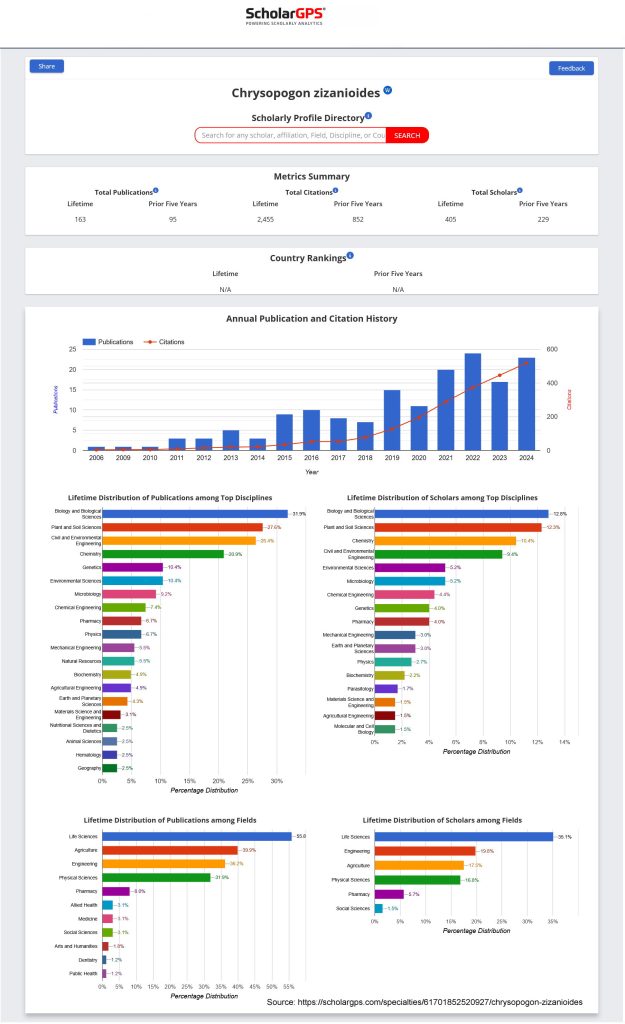 , a comprehensive database for quantifying scholarly activity worldwide (i.e., journal articles, books, book chapters, patents, and conference papers) was queried in order to identify who is publishing research work on vetiver, whose publications are being cited in other researchers’ publications, and which individuals, institutions, and subject areas are having the greatest academic impact.
The graphic on the left (which can be seen full-sized at this link) summarizes the ScholarGPS profile for Chrysopogon zizanioides. Note that it is not reporting on a literature review or providing a bibliography on vetiver, but rather shows that between 2006 and 2024, some 405 individuals have been actively researching and publishing on VGTs; of which 229 (or about 57%) have been active during the last five years.
The publication history shown in the graphic suggests that vetiver-related scholarship began to build steadily after about 2015, especially from 2019 onward. Citations show an even clearer upward trajectory. Citation totals have been climbing steadily year after year, indicating that the body of work is not only expanding, but also being used and referenced more widely across the scientific literature.
The disciplinary distribution is equally important. Publications are concentrated in Biology and Biological Sciences, Plant and Soil Sciences, Civil and Environmental Engineering, and Chemistry. The field-level breakdown likewise shows strong representation in Life Sciences, Agriculture, Engineering, and the Physical Sciences. This is relevant for the TVNI community because it confirms what practitioners have long known: vetiver is not a narrow or niche subject. It sits at the intersection of plant science, soil health, hydrology, engineering, environmental remediation, and agricultural systems.
The scholar distribution tells a similar story. Researchers working on vetiver are spread across multiple disciplines, showing that interest in the plant is broadening beyond any single application. That matters because wider disciplinary engagement often leads to stronger evidence, more innovation, and greater institutional legitimacy.
The graphic provides visible evidence that vetiver is attracting growing scholarly attention and that research activity has accelerated in recent years. For our global network and its commitment to advancing the Vetiver System, these trends reinforce the credibility of VS with researchers, donors, development agencies, governments, and practitioners by demonstrating the science base around VGTs is deepening, diversifying, and gaining momentum.
Vetiver on floating mats in temperate Japan: strong nitrogen removal, but a clear “don’t overpromise phosphorus” lesson
A recent Japanese study by Roy, Nagasaka, Sasada, and Yamazaki evaluates vetiver (Chrysopogon zizanioides) in floating treatment systems (FTS) for agricultural wastewater management in a temperate setting. The work is valuable for TVNI members because it tests vetiver across three realistic water types under outdoor conditions in Fujisawa City, Japan (June to early December): natural surface water, synthetic eutrophic water, and livestock wastewater
What they did and why it matters. The authors ran three sequential “mesocosm” experiments (definition below) in an outdoor tank (600 L per phase), using floating units covering about half the water surface. The system was static (no forced circulation/inflow/outflow) with periodic manual mixing.
Across all water types, vetiver consistently reduced total nitrogen (TN, up to ~60%) and reduced suspended solids (SS). Notably, the authors observed that a substantial portion of N and P removal occurred within 4–7 days, suggesting vetiver FTS can act faster than is often assumed.
Phosphorus results in particular are interesting. Total P (TP) decreased strongly under nutrient-rich conditions (48.2% in eutrophic water; 25.3% in livestock wastewater), but slightly increased in the natural surface-water phase, likely tied to mineralization/desorption from particulates. Thus, phosphorus removal was more context-dependent, showing significant decreases under nutrient-rich conditions but potential for increases where releases from particulates or mineralization occurred.
In the eutrophic phase (i.e., water that is rich in dissolved nutrients, like N and P, which lead to excessive plant and algae growth), dissolved oxygen fell sharply (14.7 → 1.8 mg/L). The study also reports nitrite accumulation (5,145 mg) after FTS installation, interpreted as incomplete nitrification under oxygen-limited conditions—a practical flag for high-organic/algae-rich waters unless aeration/mixing/loading are managed.
Bottom line for TVNI members: This is a solid temperate-climate proof point for vetiver floating systems—especially for nitrogen and solids—while providing clear evidence that phosphorus performance is context-dependent and that oxygen regime can make or break nitrogen transformations.
Definition: A mesocosm (meso- or ‘medium’ and -cosm ‘world’) is any outdoor or indoor experimental system that examines the natural environment under controlled conditions. Mesocosm studies provide a link between field surveys and highly controlled laboratory experiments.
With thanks to the authors who reached out to TVNI to share their paper!
When the slope gets steeper: what happens to vetiver roots—and erosion resistance?
A 2024 paper in Catena tackles the question: how does slope angle affect root traits and the soil’s vulnerability to detachment under concentrated flow? Using topsoil collected from vetiver (Chrysopogon zizanioides) found

on 20°, 30°, and 40° slopes, the authors compared soils containing vetiver roots (VT) with soils without roots (control).
Key takeaways for VGT practitioners
1) Vetiver roots materially reduce soil detachment across all tested slopes. Soil detachment capacity was ~34.1% to 49.6% lower in the vetiver-root soils than in controls and, critically, the reduction rate did not differ by slope gradient. In other words: vetiver’s erosion-resistance benefit was robust throughout the range tested, 20° (or 36%) through 40° (or 84%).
2) Root morphology changes between 20° and 30°. Multiple root morphology indicators changed markedly from 20° → 30°, then showed no major additional change from 30° → 40° (a non-linear response that suggests a practical “change point” around ~30°).
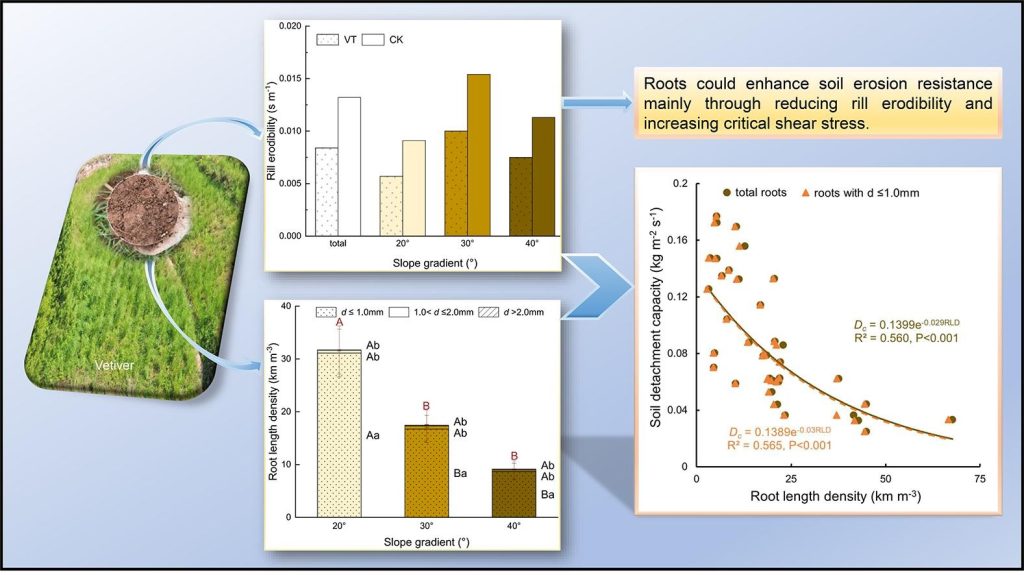

3) Steeper slopes favor coarser roots. As slopes increased, the proportion of roots >1.0 mm diameter increased, suggesting steep terrain may promote relatively coarser roots.
4) A clean mechanism you can cite in proposals: Detachment capacity declined exponentially as root morphology “increased”—supporting the idea that measurable root traits (e.g., root length density / surface area density) can serve as practical proxies for erosion resistance.
Why this matters. For watershed committees, road agencies, and project appraisals, this paper strengthens the case that vetiver’s root reinforcement is not just adequate on moderate slopes, but remains effective on steep slopes—while also signaling that additional attention should be given in the establishment of vetiver when slopes are around the ~30° transition zone, in order to ensure strong root development (e.g., use quality planting material; apply soil amendments at planting such as manure, fertilizer, AMF inoculant; close spacing 10-15cm; ensure adequate moisture for establishment, etc.).
Southernmost vetiver and a note on cold tolerance
Translation: Hello Vetiver friends! I share with you a photo of what I suppose must be the southernmost Vetiver in the world. It is located at my mother’s house in Comodoro Rivadavia, a cit

y in southern Patagonia and was planted 3 years ago. It has withstood sub-zero colds, snowfall and winds of 120 km/h, this somehow indicates that Vetiver can perfectly acclimatize to cold areas.
In the WhatsApp chat, Rafael Luque (coordinator of the Latin American Vetiver Network), responded to Fabián’s posting: “I believe, as you do, that this plant is the southernmost that exists. Although there is reference that the plant tolerates temperatures from -15°C to 60 ° C, it is always located as a limit in subtropical zones; but Comodoro Rivadavia is located at a latitude much further south (more than 22° beyond the tropics), so it belongs to the Patagonian cold temperate zone, not subtropical.”
John Greenfield, the founder of modern VGT, used as a rule of thumb that planting vetiver above 30° north latitude was risky, due to vetiver’s limited cold tolerance. Prior to Fabian’s post, the furthest southern site where we know vetiver has been grown was in Nelson, New Zealand, which is located on Tasman Bay at -41.289442° (vs Comodoro Rivadavia, Argentina at -45.845729°).
Still, a latitude limit for vetiver is really a proxy for winter minimum temperature, not a true biological rule. So, for practical planning, it is better to use your locally available information on the winter minima isotherms (or, in the USA, the USDA hardiness zones) rather than latitude. In any particular place, vetiver’s survival will depend heavily on:
- duration of freezing, not just the absolute minimum,
- soil temperature,
- whether the ground freezes,
- elevation,
- continental vs. coastal climate,
- and whether plants are old, established clumps rather than young transplants.
Cold-tolerance reports for vetiver show it can survive severe short cold events in some cases, but prolonged subzero conditions remain the real constraint.
Paul Troung’s 2015 presentation on Cold Tolerance of Vetiver Plants is still one of the best summaries we have on this topic. It states that vetiver is substantially more cold-tolerant than often assumed, showing through field examples from Australia, Chile, China, Georgia in the United States, and a snow trial that established plants can survive severe frost, short periods of very low temperatures, and even snow cover, although top growth may be burned back or temporarily stopped. It inform us that vetiver’s real limit is not ordinary frost or brief snow cover but frozen ground: shoots may die back, leaves may turn purple-red under cold stress, and growth may slow sharply, yet the plant can recover in spring if the root zone does not freeze. Supporting research cited in the slides indicates that root growth is optimal around 25°C, continues even at about 13°C, and likely becomes dormant only near 5°C, while dense, established clumps protect inner shoots better than isolated plants. The practical takeaway is that vetiver can remain viable and even continue limited treatment functions in cold winters, but performance is reduced, and in colder sites winter protection such as a simple plastic cover may be needed.