The two attached documents make a complementary case for the Vetiver System (VS) as a living, low-cost means of protecting river, canal, dam and sea banks against flood and wave erosion. The first sets out the underlying method and a broad international field record; the second follows one national program through a full decade to test how that method holds up over time — the successes and the failures alike. Read together they move from principle and proof-of-concept to durable, honestly audited outcomes.
Document 1 — The Presentation
Vetiver System for Stream Bank Stabilization With special reference to river and canal bank stabilization in Australia and Vietnam
This presentation by Paul Truong — Director, The Vetiver Network International; sets out the case for VS as a natural engineering structure. Paul Truong begins from the physics common to all slope failure — driving forces overcoming the shear strength of the bank — and notes why water-retaining structures are especially vulnerable: flowing water and waves undercut the toe of the slope, saturate and load the soil, and steadily weaken the bank until it collapses. Vetiver counters this on several fronts at once. As a wetland plant it withstands prolonged submergence (hedges survived months beneath 15–20 m of Mekong floodwater in Cambodia); its deep, strong roots resist washout at high velocity; and its stiff, erect stems slow the flow and trap sediment, staying upright in water up to roughly 0.6–0.8 m deep and banking water to 600 mm in flume tests, while the leaves bend under deeper, faster flow to shield the soil surface beneath. On embankments the hedges also cut wave run-up and the retrogressive erosion that occurs as water retreats.
The strength of the presentation is its field record. Across Australia, Vietnam, Cambodia, China, Malaysia, the Philippines and South Africa, Truong documents both the repeated failure of conventional approaches — water hyacinth, native grasses and Phragmites, bamboo, casuarina and coconut, concrete plate covers, and the rock baskets, gabions and rip-rap that collapsed and were rebuilt time and again on the Red River in Hanoi — and the durability of vetiver by contrast. At the Columboola Creek bridge abutment in Queensland, erosion was halted within 18 months of planting and the site held through five years of flash floods; in a Laidley drainage channel three-month-old hedges withstood flows estimated up to 5 m/second with only minor scour. An Australian consultant’s costing quoted in the presentation places vetiver at about A$15,000 against A$195,000 for dumped rip-rap and A$1.7 million for a concrete pile wall. Following the recommended layout — a bank slope no steeper than about 2.5:1 with rows planted both parallel to the flow and across it — the evidence supports water management as vetiver’s master function and offers a practitioner-ready template for demonstration on erosion-prone banks.
Document 2 — The Ten-Year Field Audit
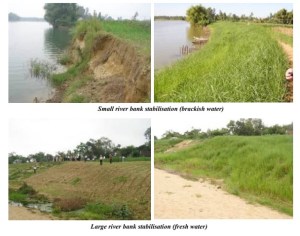 VST in River and Canal Bank Stabilization in Central Vietnam – Successes and failures ten years later
By Tran Van Man (Vietnam Vetiver Network / SBTV Co., Da Nang), Huynh Van Thang (Agriculture and Rural Development Department, Danang) and Paul Truong (TVNI Director for Asia and Oceania, Brisbane)
This paper follows VS through a full decade of service on the river and canal banks of coastal central Vietnam. It begins with the Quang Ngai Natural Disaster Mitigation Project — an AusAID-funded response to the late-1999 typhoon that killed close to a thousand people and caused more than US$340 million in damage — within which vetiver was trialled as a living alternative to concrete for anti-salinity dike and riverbank protection. Its most valuable feature is candor: rather than a showcase, it is an honest audit of what worked and what did not. The authors record the initial institutional reluctance, counterpart agencies holding that the higher-velocity flows of central rivers made northern and southern delta experience non-transferable and refusing vetiver for “permanent” structures, and then chart how the trials changed that position. Vetiver established in soils from loose sand to compacted laterite, resisted flood flows within three months of planting, and trapped silt even as young beds; where roots would not hold in saline sandy ground, mangrove fern and salt-tolerant species were planted at the toe. The demonstrations at the My Phuoc revetment ultimately persuaded agencies to recommend vetiver for banks that rock and concrete could not protect economically, and in neighboring Danang the technology was certified by the Ministry of Science and Technology and given an official “vetiver rate” for costing.
The ten-year re-assessment is the paper’s payoff: no significant failures at the maintained sites, with success shown to depend on two things — community awareness that vetiver “is not just another grass” and ongoing maintenance through weeding and occasional fertilization. It is equally clear about the failure modes, which are social and managerial rather than hydraulic: grass removed for crop production or out of fear of harboring snakes and rats, weed invasion and overshading where maintenance lapsed, and slow growth on hard, low-fertility soils. A striking counter-current runs through the account — while government adoption was slow, community groups moved quickly, the An Chau village scheme on the Tra Bong river being planned and built almost entirely with local resources on a reshaped 1V:2H bank planted to a one-meter grid with guinea grass between the rows and bamboo-and-timber toe protection. The overriding lesson, and the one most useful, is that VS delivers durable, low-cost protection against flash flood and saltwater intrusion when it is correctly designed, applied and — above all — sustained by an informed community, with the main barrier to wider uptake being the absence of nationally recognized design guidelines rather than any shortcoming of the grass.
Note: Figures, case results and cost comparisons above are drawn directly from the attached documents. Cost figures are those of the cited Australian consultant report and are indicative of relative order-of-magnitude, not current prices.