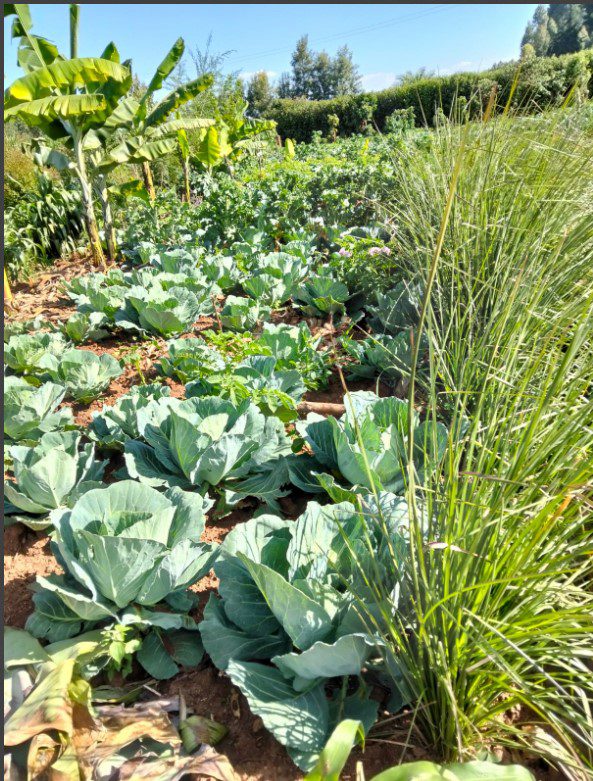
Think of degraded soil at 1.5% organic matter barely supporting crops. Now imagine bringing it to 4.3%. That’s what Anno Farms in Ethiopia achieved over 15 years with vetiver. Not guesswork—measured data from a 200-hectare commercial operation. Here’s how:
- THE DOUBLE BIOMASS TRICK
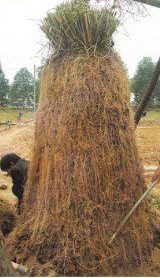
Most people see the 1.5-2 meter tall vetiver canopy and think “that’s a lot of mulch.” They’re seeing only half the story.
Above ground, standard vetiver hedges deliver 6-12 tons per hectare every three years. Intensive systems deliver 23-42 tons. The rotational system delivers 66-102 tons.
Below ground? The same amount or MORE. Vetiver’s root-to-shoot ratio is 1:1 to 1:2. Most grasses run 1:5 to 1:8. This means for every ton of leaves you can see, there’s another ton of roots you can’t—diving 3-5 meters deep, dying off, regenerating, feeding the soil profile from top to bottom.
That below-ground biomass is the game-changer. Surface mulch is great. Deep carbon sequestration throughout the entire soil profile? That’s permanent transformation.
Total organic matter input: 9-18 tons (standard hedges) to 83-130 tons (rotational system) per three-year cycle. Composting delivers 15-30 tons—all surface application, zero deep carbon.
- THE MICROBIAL EXPLOSION
Vetiver doesn’t just add organic matter. It creates a living factory that PRODUCES nutrients from air, water, and rock.
Those deep roots? They’re surrounded by something called the rhizosphere—a zone where roots feed billions of bacteria and fungi. These microorganisms don’t just decompose organic matter. They actively mine nutrients from soil particles, pull nitrogen from air, dissolve phosphorus from rock, and create complex compounds that crops can’t make themselves.
The Anno Farms measurement: Microbial biomass increased 200-500% over 15 years. That’s not two times more microbes. That’s five times more. Each gram of soil went from hosting maybe 100 million organisms to hosting 300-600 million organisms—all working as nutrient engines.
When you cut vetiver for mulch, you’re harvesting the visible part. When you leave the roots in the ground, you’re keeping the nutrient factory running 24/7.
- THE UNDERGROUND INTERNET
Here’s where it gets wild. Those vetiver roots don’t work alone. They partner with mycorrhizal fungi—organisms that form thread-like networks spreading 10-15 meters from each hedge.
Think of it as an underground internet for your farm. The fungal threads connect to your crop roots and deliver water and nutrients directly—sometimes from 15 meters away. Your tomatoes growing 8 meters from the hedge? They’re plugged into the vetiver’s deep mining operation through the fungal network.
This extends your crops’ effective rooting zone by 10-100 times. A maize plant with a 50cm natural root spread suddenly has access to nutrients from a 5-10 meter radius. It’s not getting those nutrients from surface fertilizer. It’s getting them from deep soil layers the fungi are accessing.
The network is field-wide. One hedge feeds another. Crops in the middle of your field benefit from hedges at the edges. It’s a nutrient distribution system that runs on biology instead of diesel.
- THE NUTRIENT AMPLIFICATION EFFECT
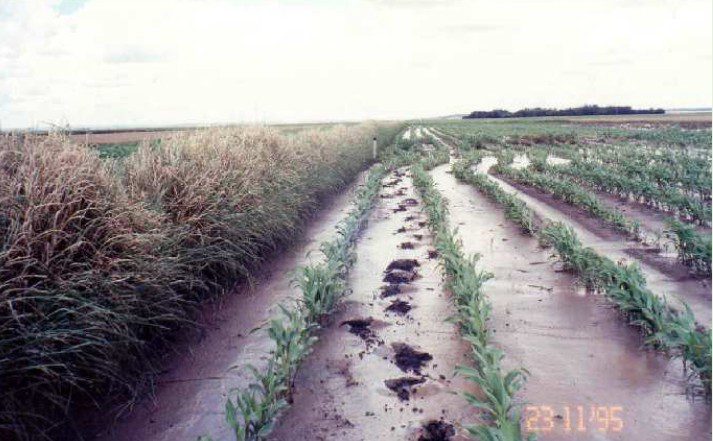
Now watch what happens when you combine massive biomass + microbial explosion + fungal networks:
Anno Farms Ethiopia, 15-year validated study:
- Soil organic matter: +59% (from 2.7% → 4.3%)
- Available phosphorus: +100%
- Available potassium: +54%
- Total nitrogen: +33%
That phosphorus number is critical. Phosphorus doesn’t move in soil—it’s typically locked in rock. Plants can’t access it. But those billions of microbes and mycorrhizal fungi? They dissolve it, transport it, deliver it. The phosphorus was always in your soil. Vetiver made it available.
The rotational system with complete field coverage projects even bigger gains: 150-300% organic matter increases over 15 years. Degraded soil starting at 1.5% hitting 3.5-6%. That’s not incremental improvement. That’s fundamental transformation of the land’s productive capacity.
- THE WATER-FERTILITY MULTIPLICATION
Here’s the connection most people miss: fertility improvements only matter if water is available to carry nutrients to crops. Vetiver’s 3-5 meter roots create permanent channels through hardpan and compacted layers. Water that used to run off now infiltrates 2-18 times faster. Soil moisture retention jumps 30-80%.
Wet soil activates the microbial engines. Dry soil shuts them down. By fixing the water problem first, vetiver allows all that microbial activity and nutrient cycling to function continuously instead of sporadically.
The mycorrhizal networks? They transport water too. During dry spells, those fungal threads pull moisture from deep zones around the vetiver (which is still accessing water at 3-5 meters) and deliver it to your crops. It’s drought insurance built into the fertility system.
THE GRADIENT
Right at hedge (0-2m): 100-200% fertility improvement
Near hedge (2-5m): 50-100% fertility improvement
Whole field: 25-60% fertility improvement (depending on hedge spacing)
Closer spacing = more complete coverage. The rotational system at 1-meter spacing covers 100% of the field over the 3-year cycle. Every square meter gets the full treatment.
THE CHEMICAL FERTILIZER SHIFT
Most farmers aren’t trying to eliminate fertilizer. They’re trying to make it WORK.
On degraded soil with 1.5% organic matter and collapsed biology, you might apply 100kg of fertilizer and crops access maybe 20-30% before the rest leaches away or locks up. You’re paying for 100kg but getting 20-30kg worth of results.
On vetiver-improved soil with 4% organic matter, massive microbial populations, and active mycorrhizal networks, that same 100kg delivers 60-80% efficiency. The nutrients get held in organic matter, processed by microbes, transported by fungi, and delivered to crops over weeks instead of washing away in days.
The practical outcome: 30-70% fertilizer reduction while maintaining or increasing yields. The fertilizer you DO apply works 2-3 times better.
Anno Farms measured: 59% organic matter increase translated to yield improvements of 25-40% while using less fertilizer per kilogram of crop produced.
YOUR COFFEE/VEGETABLES/MAIZE:
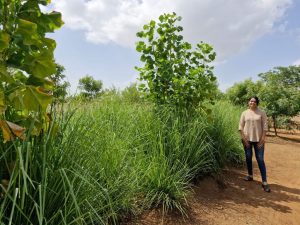
Standard vetiver hedges (500 meters per hectare): Measurable fertility improvements in 2-3 years, transformational change in 5-10 years, permanent baseline elevation.
Intensive hedges (4-8 meter spacing): Aggressive fertility building, 50-80% yield improvements after establishment, field-wide coverage.
Rotational system: Complete field transformation in 3-year cycles per section, 80-150% yield improvements possibleon severely degraded soils (reflecting restoration from very low baselines).
THE PROOF IS IN THE NUMBERS
This isn’t theory. Multiple long-term studies tracked soil samples on actual farms:
Anno Farms, Ethiopia – 200-hectare commercial operation tracked for 15 years. Starting conditions: degraded soil, low organic matter, poor yields. After 15 years with vetiver hedges: +59% organic matter, +100% available phosphorus, +54% potassium, +33% nitrogen, 200-500% more soil microbes.
Nigerian Research – Using African vetiver (Chrysopogon nigritana) in Nigerian conditions with Nigerian crops: 289% cassava yield increase, 89% maize yield increase, 91% carbon loss reduction, 80% nitrogen loss reduction.
Chinese Agricultural Research Network – Documented 34.8% corn yield increases using vetiver as green manure across multiple sites.
It’s not magic. It’s massive biomass input (above and below ground) + microbial amplification + mycorrhizal networks + improved water retention working together over time.
The question isn’t whether it works. The question is how fast you want the transformation: standard hedges over 10 years, intensive hedges over 5 years, or rotational system over 3-year cycles.
Your degraded soil isn’t broken. It’s starved of organic matter, depleted of biology, and suffering from collapsed water infiltration. Feed it. Restore the biology. Fix the hydrology.
Vetiver does all three simultaneously.
Based on validated field data: Anno Farms Ethiopia 15-year study (Gesesse et al. 2013), Nigerian research Ogbomoso region (Oku et al. 2015, 2016), Chinese agricultural research network (Lu & Zhong 1998), Kenya ASAL field trials, and global Vetiver Network International documentation.
I love the this vetiver information