NEWSLETTERS & POSTS

Vetiver as Vetiver Forage: What the Evidence Really Shows, a Drought Resilient Feed

Across the tropics, livestock producers face a recurring challenge: how to maintain animals through long dry seasons, drought cycles, and periods when conventional fodder collapses. Vetiver grass, long celebrated for its engineering and environmental benefits, is increasingly recognized as a strategic forage reserve—not because it outperforms improved fodder species, but because it survives when everything else fails. Nutritionally, vetiver is a moderate‑quality tropical roughage. Crude protein typically ranges from 6–10%, with digestibility values comparable to hardy, low‑input grasses used in drylands.… Read the rest “Vetiver as Vetiver Forage: What the Evidence Really Shows, a Drought Resilient Feed”

From Sixty Plants to System‑Wide Protection: The Vetiver Standard

For nearly 40 years, the Vetiver Grass Technology (VGT) has been recognized worldwide for its unmatched performance in soil conservation, slope stabilization, hydrological protection, and watershed rehabilitation. But one of its most powerful biological functions—its ability to act as a dead‑end trap crop for stemborers in rice, maize, and sorghum systems—has remained largely hidden in plain sight. Today, with evidence accumulated from India, China, East Africa, and Southeast Asia, TVNI is releasing a consolidated global standard that finally brings this capability to the forefront of agricultural practice.… Read the rest “From Sixty Plants to System‑Wide Protection: The Vetiver Standard”

Vetiver Grass Technology, Nematodes, and Crop Health: A New Biological Paradigm for Tropical Agriculture

For decades, root‑knot nematodes (Meloidogyne spp.) have quietly undermined tropical agriculture, reducing yields in bananas, chilli peppers, tomatoes, cassava, sweet potato, and dozens of other crops. Their damage is often misdiagnosed as drought stress or nutrient deficiency, leaving farmers with few effective options beyond costly and increasingly restricted chemical nematicides. Yet emerging evidence reveals that a widely planted tropical grass — vetiver (Chrysopogon zizanioides) — possesses a unique biological capacity to suppress nematode populations through a combination of chemical, ecological, and microbial mechanisms.… Read the rest “Vetiver Grass Technology, Nematodes, and Crop Health: A New Biological Paradigm for Tropical Agriculture”

Vetiver Grass – The Microbial Engine that drives the Vetiver Grass Technology – Transforming Vetiver Plant Establishment, Perennial Cropping Systems, and Soil Restoration

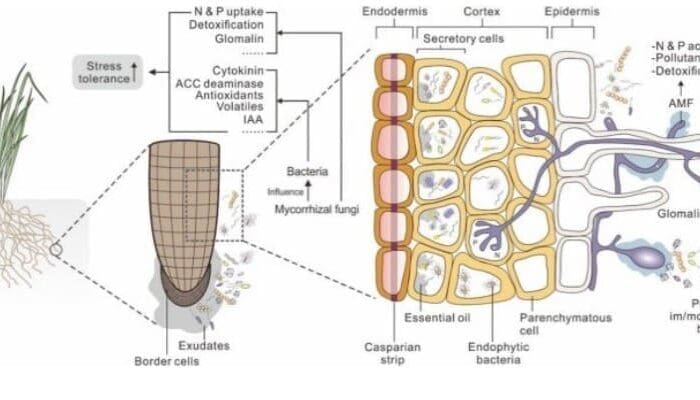
The Microbial Engine Behind Vetiver’s Exceptional Performance .   Across the tropics, vetiver grass has earned its reputation as one of the world’s most resilient biological tools for soil and water conservation. Its deep, fibrous roots anchor slopes, its dense hedges slow runoff, and its physiology thrives where most plants fail. Yet the true engine behind vetiver’s extraordinary performance lies beneath the surface: a powerful, stress‑tolerant microbial community that transforms degraded soils into living, functional ecosystems. This document brings together global field evidence, emerging research, and decades of practitioner experience to explain how microbes accelerate vetiver establishment, strengthen perennial systems, and restore soil health at scale.… Read the rest “Vetiver Grass – The Microbial Engine that drives the Vetiver Grass Technology – Transforming Vetiver Plant Establishment, Perennial Cropping Systems, and Soil Restoration”

Newsletter (NL2026-01) Vetiver Grass Technology – Read and Think Deep!

The Five Non‑Negotiables for Successful Vetiver System Establishment Effective vetiver installations don’t happen by chance. They require disciplined quality management with trained supervision to ensure every step—from cultivar selection to long‑term maintenance—meets Vetiver Grass Technology (VGT) design and application standards. When these fundamentals are assured, performance is predictable, costs stay low, and hedges last for decades. 1. Approved Vetiver Cultivar Use only sterile, deep‑rooted planting stock with verified provenance. 2. Quality‑Assured Planting Material Supply live, vigorous slips grown, prepared, and shipped in full compliance with standards.… Read the rest “Newsletter (NL2026-01) Vetiver Grass Technology – Read and Think Deep!”

A new technical reference and guide for slope stabilization from Dr. Mohammad Shariful Islam

The Vetiver Network International is pleased to present this new technical reference and guide: Standard Specification for Slope Stabilization Using Vetiver Grass. Authored by Dr. Mohammad Shariful Islam, a distinguished researcher and practitioner in the field of bioengineering, Dr. Islam’s work has advanced the understanding and application of Vetiver Grass Technology (VGT) as a nature-based solution for mitigating soil erosion and stabilizing critical infrastructure. The author shares his knowledge and long experience, which he has gained both from his research and field applications.… Read the rest “A new technical reference and guide for slope stabilization from Dr. Mohammad Shariful Islam”

New Experimental Evidence: Vetiver Nearly Eliminates Runoff — What This Means for Micro Catchment Restoration

For years, practitioners across the Vetiver Network have known — from field experience, hydrological logic, and scattered academic studies — that vetiver hedgerows dramatically increase infiltration and reduce destructive runoff. Yet one of the persistent barriers to institutional uptake has been the absence of simple, intuitive, quantitative demonstrations that show just how much difference vetiver makes under real rainfall. A new 400‑day experiment from Maharashtra (India) carried out by Chandrashekhar Bhadsavle, Anil Nivalkar, Parshuram Agivale – paper attached –  fills that gap with remarkable clarity.… Read the rest “New Experimental Evidence: Vetiver Nearly Eliminates Runoff — What This Means for Micro Catchment Restoration”

Newsletter (NL 2025-12) – a year in review & other news

The Vetiver System in 2025 The most outstanding aspect of the Vetiver System in 2025 were the people of the VS global community.  WhatsApp groups in India and Latin America, the monthly Latin American Conversatorios, and numerous active Facebook groups carried on wide-ranging discussions that moved riverbanks in Vietnam to hillside farms in India, to coastal landscapes in Latin America, and land restoration in Africa. A grower showed how chop-and-drop vetiver mulch held moisture through drought; another captured riverbanks that stayed intact after storms when vetiver was an integral part of a bioengineering scheme.… Read the rest “Newsletter (NL 2025-12) – a year in review & other news”

Newsletter (NL 2025-11) – Mine Restoration – Knowledge Resources – Global Voices

From Scarred Mines to Blueberry Fields: A Story of Restoration from South China. In Baisha Town, Yingde City, the scars of illegal rare earth mining once defined the landscape. Jagged rocks and barren soil stretched across Mendong Village’s Fourth Pond, a stark reminder of ecological damage. Today, that same ground is alive with vetiver grass and rows of blueberry bushes — a living testament to how innovation and determination can turn devastation into opportunity. In 2023, Baisha Town has invested more than USD4 million in an ambitious 114 ha restoration project.… Read the rest “Newsletter (NL 2025-11) – Mine Restoration – Knowledge Resources – Global Voices”

Newsletter (NL 2025-10) WhatsApp to Watersheds: Peru Testimonial, Innovations, Impacts, and Economics, and WhatsApp Chat Insights

A testimonial from Alois Kennerknecht : The Vetiver System – a multipurpose plant in an urban community in Peru A few months ago TVNI launched a “Vetiver Testimonial Campaign” with an open call, asking you to share your stories and the positive impacts it has had in your and/or your community’s life. This is important because while data shows that the Vetiver System works, your stories shows why it matters. When decision-makers and leaders can hear — in your words — how vetiver protected your farm and restored soil health or, protected your home and livelihood, or helped solve a previously unsolvable problem, they connect, trust, and act.… Read the rest “Newsletter (NL 2025-10) WhatsApp to Watersheds: Peru Testimonial, Innovations, Impacts, and Economics, and WhatsApp Chat Insights”