Dates for the 8th International Conference on Vetiver (ICV-8) Announced
The following is an official announcement from the India Vetiver Foundation:
The India Vetiver Foundation (IVF) is proud to announce that India will host the Eighth International Conference on Vetiver (ICV-8) in Chennai from 12 to 14 May 2027. The conference will bring together researchers, farmers, policymakers, and practitioners from across the world to advance the science, cultivation, and application of vetiver grass for soil and water conservation, environmental restoration, bioenergy, and rural livelihoods.
India last hosted the international vetiver conference in 2011, when ICV-5 was held in Lucknow. ICV-8 marks the return of this global gathering to Indian soil, and reflects the renewed momentum behind vetiver work in the country since the founding of IVF in December 2023.
“Vetiver is one of the most versatile and under-appreciated plants available to us — for erosion control, water purification, carbon sequestration, bioenergy, and livelihoods for smallholder farmers,” said Dr. C.K. Ashok Kumar, President and co-founder of IVF.
“Bringing ICV-8 to India gives us the platform to showcase what our farmers and researchers have achieved, and to learn from the wider global network.”
IVF Vice President P.N. Subramanian, who attended ICV-7 in Chiang Mai in 2023 has been leading preparations for ICV-8, including a series of regional vetiver conferences across India as lead-up events.
2027 also carries special significance for the international vetiver community. It marks the centenary of the birth of His Majesty King Bhumibol Adulyadej the Great of Thailand, whose Royal Initiative on vetiver launched Thailand’s national programme and underpinned the Vetiver System’s international dissemination, and the sixth-cycle (72nd) birthday anniversary of Her Royal Highness Princess Maha Chakri Sirindhorn, Patron of The Vetiver Network International. ICV-8 will include a dedicated commemorative session honouring this legacy.
Further details on the conference programme, call for papers, and registration will be announced in the coming months. Organisations and individuals interested in partnering with or sponsoring ICV-8 are invited to contact the India Vetiver Foundation.
About the India Vetiver Foundation
The India Vetiver Foundation (IVF), launched in Dec 2023 works to advance vetiver-based solutions across India through farmer outreach, research partnerships, conference organisation, and applications spanning erosion control, carbon sequestration, and bioenergy.
TVNI Announces Awards for ICV-8
TVNI is announcing the set of awards that it will bestow at ICV-8. The Awards are built around a single purpose: generating the types of documented, verifiable field evidence needed to argue for the Vetiver System with governments, donors, NGOs, and the private sector — and the human stories that persuade people to adopt it.
Vetiver Grass Technology Case Study Awards — three at US$1,000 each. TVNI is seeking case studies of successful VS applications in three categories: agriculture, bioengineering, and phytoremediation. Priority goes to mature applications, at least three years since establishment, where the full range of benefits is visible and attributable. Submissions use a TVNI template covering location and georeference, setting, design and spacing, age and condition, quantified results with measurement methods, costs and benefits, adoption by others, and lessons learned. Open to everyone — farmers, practitioners, researchers, engineers, companies, NGOs, and agencies. Self-nomination is expected. Honest reporting counts: a case study that plainly states a figure is a farmer’s estimate will score better than one implying precision it does not have.
GVF Field Evidence Award — US$750. This one asks for criticism rather than success. It invites rigorous, constructive field evaluation of TVNI’s draft Global Vetiver Farmer models and monitoring protocols — their design, measurement guidance, and usability by a farmer working without outside support. Submissions must be grounded in an actual attempt to use the protocols at a real site, and every issue raised must come with a specific, drop-in fix. Desk critiques and endorsements will not be considered. An summary overview of the GVF models and protocols can be reviewed here.
Exceptional Individual Contributions — certificate only. Five awards honoring the lifetime contributions of Monty Yudelman, John Greenfield, Mark Dafforn, Nick Dolphin, and Criss Juliard. Each goes to the strongest case study in the thematic area matching the namesake’s own work. 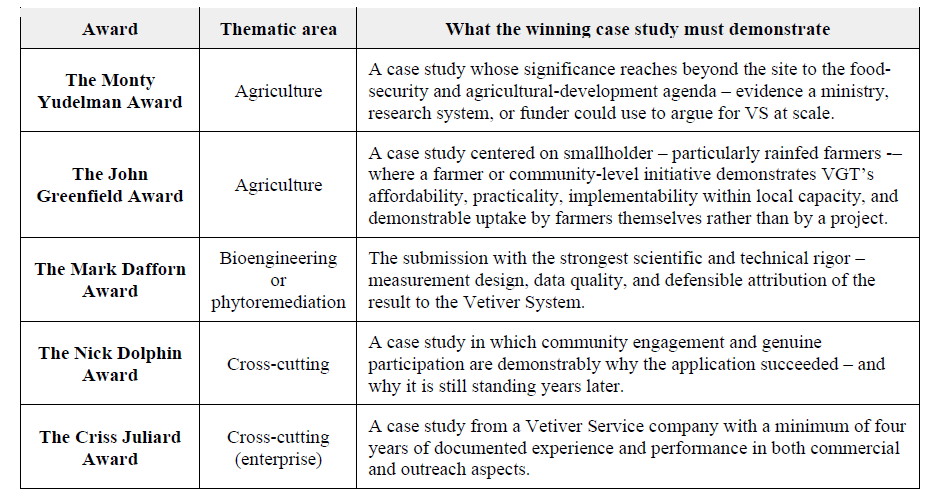
Certificates of Recognition. Every submission meeting the minimum documentation bar receives one — anyone who does the work of documenting a real application comes away recognized.
Case Study template: For a copy of the case study template, email [email protected] with the phrase “Case Study Template” in the subject line.
GVF Field Evidence Award: Interested individuals should contact TVNI at [email protected] with the phrase “GVF Field Evidence Award” in the subject line.
Deadline: 1 April 2027. Winners notified 1 May 2027; awards conferred and papers presented at ICV-8. Send submissions to [email protected] with “TVNI Award Submission” in the subject line.
Full details may be found here
2026 is the UN International Year of the Woman Farmer: Vetiver and Women Farmers
Roughly half the world’s smallholder farmers are women and, as this year is the UN’s International Year of the Woman Farmer, it is a good time to reflect on what we know and don’t know so far about VS gender aspects.
For starters, unfortunately we know relatively little. For example, to our knowledge, no experimental study of gender and vetiver has been carried out anywhere (ATTENTION SOCIAL SCIENTISTS), and the handful of papers that do come up when you research the topic do not actually carry much weight. Still, experience throughout the vetiver networks, plus a couple of rigorous outside studies, do offer some solid insights.
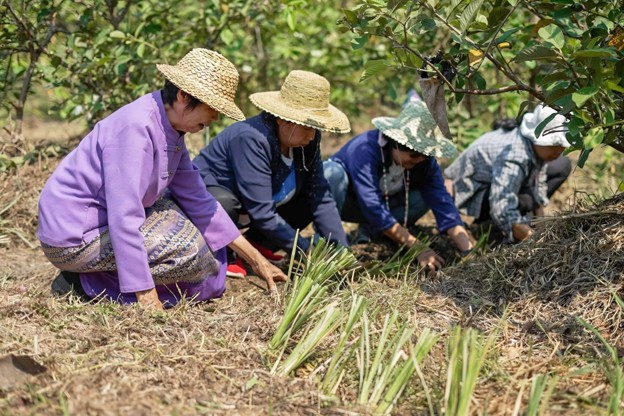
Start with tenure – but check which way it runs. In many customary systems, whoever holds less secure land rights invests less in perennial conservation measures. In much of patrilineal sub-Saharan Africa that’s women, and TVNI’s own network reports that vetiver – perennial but not a tree – often escapes the restrictions that block planting trees or building structures on land a woman farms but doesn’t own. But the relationship isn’t fixed: a large, geocoded Malawi study of over 9,000 households found that in matrilineal-matrilocal communities – where the husband moves onto his wife’s land – it is men who hold the insecure tenure, and who invest less in soil conservation, vetiver planting included (Lovo, 2016). Ask locally who is tenure-insecure.
Vetiver already spreads widely on its own. In a 1,947-plot survey across 893 Malawian farmers, vetiver was the single most-adopted conservation practice – 43.8% of plots, ahead of tree belts (16.4%) and irrigation (9.8%). Notably, formal land demarcation increased investment in irrigation and drainage but not in vetiver, suggesting its uptake isn’t necessarily bottlenecked by formal tenure status the way structural investments are (Mkandawire et al., 2025).
Lead with the use she names. In Ogbomoso, south-western Nigeria, 400 farmers ranked their actual uses of vetiver: pest control first, animal feed second, roofing third, herbal skin care fourth – with erosion control fifth of six. Open with fodder, thatch or stem-borer control and the soil conservation follows.
The gap is in reach, not receptivity. In that same survey, 46% of men and 42% of women knew vetiver could control erosion – and why farmers adopted showed no gender difference at all. Women were not less persuaded; they were slightly less reached. Farmers named neighbors (27%) and extension agents (25%) about equally as their source, while 24% had no knowledge of the grass at all. Invest in both channels.
Quote the labour. Women generally command less labor than men, which is why stone bunds and fanya juu stall. Ethiopia’s Amhara program recorded farmers planting about 740 feet (225 m) of hedgerow per person-day on 5–15% slopes, and 655 feet (200 m) above 15%.
Do not assume which way gender runs, on adoption either. In Haru district, western Ethiopia, 73.5% of male household heads had hedgerows against 48% of female heads. In Abia State, Nigeria, most adopters were women, and adoption cut poverty incidence by 21%. Survey your own site.
Deliver training to women directly. A Ugandan experiment found that targeting information to the females who were co-heads of the household, raised their knowledge, adoption and yields. This Ugandan experiment was testing for vetiver, but the lesson is likely valid for vetiver as well.
Two risks. Adoption can add to women’s labor without adding to their income. And men often take over by-products once they become profitable – a potential hazard for vetiver oil and handicraft chains, where women’s work is concentrated in the low-margin steps. Settle who owns the biomass and the income at the outset.
Then document it. Practitioner records remain better evidence than the journals on most of these questions. Consider a submission to the TVNI ICV-8 Awards and to FAO’s Year of the Woman Farmer story call.
Sources
- TVNI, NL-2024-07, “Is there anything that makes Vetiver more relevant to women than men?” – https://vetiver.org/vetiver-roots-as-a-temporary-carbon-sink-china-vetiver-network-publications-vetiver-and-women-vetiver-and-regenerative-ag-a-bi-national-program-and-other-news-nl-2024-07/
- Lovo, S. (2016), “Tenure Insecurity and Investment in Soil Conservation: Evidence from Malawi,” World Development 78:219–229 – https://doi.org/10.1016/j.worlddev.2015.10.017
- Mkandawire, N.D. et al. (2025), “Assessing the impact of land tenure security on farm-level investment in soil and water conservation practices: evidence from smallholder farmers in Malawi,” Land Use Policy 159 – https://www.sciencedirect.com/science/article/abs/pii/S0264837725003370
- Ewetola et al. (2021), Bull. Natl. Res. Cent. 45:30 – https://doi.org/10.1186/s42269-020-00483-w (concerns Vetiveria nigritana*, not* C. zizanioides*)*
- Alemu Mekonnen, IFSP Amhara, Ethiopia – https://vetiver.org/ETH_eithopia.htm
- Hailu & Hailu (2021) – https://doi.org/10.11648/j.jenr.20211001.12
- John et al. (2022), Abia State – https://doi.org/10.54536/ajaset.v6i2.310
- Lecoutere et al. (2023), World Development – https://doi.org/10.1016/j.worlddev.2023.106240
- FAO, International Year of the Woman Farmer 2026 – https://www.fao.org/woman-farmer-2026
Vetiver Research News
This is an ongoing feature of the Vetiver Newsletters where we highlight recent research (from 2026 in this case) from peer-reviewed research, credible technical and institutional reports, substantive practitioner analysis, and preprints. The intent is to identify new and relevant and value-added information on the Vetiver System (i.e., not information that only tells us what we already know) that informs us on such critical topics as scaling nature-based solutions for land, water, climate adaptation, erosion control, wastewater, and smallholder use/applications.
A Land Tenure Study in Malawi Provides Insights on Farmer’s Adoption of Vetiver
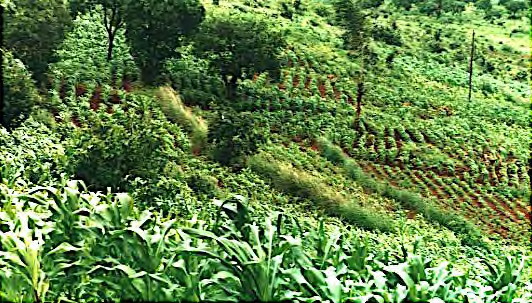
A new study in the journal Land Use Policy isn’t about vetiver per se. Researchers set out to answer a different question: does giving Malawian farmers clear, formal boundaries for their land make them invest more in conservation? But, as vetiver turned out to be the most common practice the farmers used, the study ends up giving us some very interesting insights into farmer behavior and vetiver usage in Malawi.
(Source: https://vetiver.org/vetiver_files/TVN_Webinar_1o.pdf)
The researchers surveyed 1,947 farm plots belonging to 893 farmers across six districts in Malawi. They found farmers using six conservation practices: vetiver grass, tree belts, water bunds, drainage ditches, terraces, and irrigation. The researchers applied careful statistical methods to separate real cause-and-effect from simple coincidence – an unusually rigorous approach for this kind of farm survey.
Here’s what stood out for vetiver:
Vetiver was the dominant conservation technology adopted by farmers. Nearly 44% of all plots had vetiver on them – almost three times the rate of the next most common practice, tree belts (16%). Water bunds, drainage ditches, terraces, and irrigation all trailed far behind.
Formal land rights didn’t matter for vetiver – but they mattered greatly for other practices. Farmers with officially marked-out land boundaries were significantly more likely to invest in water bunds, drainage ditches, and irrigation. But having formal boundaries made no real difference to whether a farmer planted vetiver, tree belts, or terraces. In plain terms: vetiver spread on its own, whether or not a farmer had secure, formal tenure on their land. The costlier investments were the ones that awaited secure tenure.
Vetiver was the only practice with no gender gap. Tree belts and terraces were significantly more common on plots managed by men or jointly by couples than on plots managed by women alone. Vetiver showed no such gap – women farmers were just as likely to use it as anyone else. That’s a meaningful, data-backed sign that vetiver may avoid some of the barriers – land rights, money, labor – that hold
back women’s investment in other conservation methods.
Vetiver goes together with tree belts but seems to replace bunds and ditches. Farmers who planted vetiver were also more likely to plant tree belts alongside it – the two seem to complement each other, likely because tree belts add things vetiver doesn’t, like fuelwood or shade. But farmers who planted vetiver were less likely to also build water bunds or dig drainage ditches. The study’s authors chalk this up to farmers not having enough land or labor to do everything. But there’s a simpler explanation worth considering: vetiver achieves the same objectives – holding moisture and slowing runoff – as a bund or a ditch, and that at a fraction of the land and labor cost. As vetiver solves the problem, there’s little reason to then dig a ditch.
A caveat: this comes from one World Bank-funded program in six Malawi districts and it should not be assumed to necessarily apply elsewhere. Still, it provides real-world, large-scale evidence of how vetiver actually spreads compared to its alternatives, and it’s some of the best research data we have seen .
Source: Mkandawire, N.D., Mangisoni, J., Pangapanga, I., & Machila, K. (2025). Assessing the impact of land tenure security on farm-level investment in soil and water conservation practices: Evidence from smallholder farmers in Malawi. Land Use Policy, 159, 107803. https://doi.org/10.1016/j.landusepol.2025.107803
Vetiver Research Maturing from “Does It Work?” to “How Best to Use It?”
Here we looked at twenty-three recent that provided some tangible value-added to the body of existing vetiver research. A more detailed overview of the articles – with the citation, a brief description of the work, what is value-added about it, and any relevant caveats – can be found here.
In their aggregate, these papers all point to the same conclusion: vetiver research is maturing. In the past, the dominant question was whether the Vetiver System works – across erosion control, slope stabilization, contaminated soils and wastewater treatment; that case is now well-settled. The important research questions now are how, where, and in what configurations does VGT best perform.
These recent papers make that shift explicit. A direct-shear study across seven Andean soil types found that root reinforcement is soil-dependent rather than a single generic “vetiver factor” (Plants, 2026). A flume and slope-stability study on riverbank clay under fluvial scour quantified how vetiver changes calculated safety factors under real hydraulic conditions (Ecological Engineering, 2026). Wastewater researchers are now treating planting density and hydraulic retention time as design variables: a municipal study in Bahir Dar, Ethiopia compared 20, 40 and 60 plants/m² (Scientific Reports, 2025), while a pilot floating wetland in India tuned a 24-hour retention time to reach 92% TSS removal (Journal of Environmental Management, 2026).
Just as notable is a shift away from treating vetiver as a stand-alone intervention and toward engineering it into hybrid systems. A Moroccan olive-mill trial combined vetiver-planted filters with trickling filtration and activated sludge to treat polyphenol-rich wastewater (Scientific African, 2025). Other 2026 papers pair vetiver with jute geotextile during establishment, convert spent roots into biochar for heavy-metal water treatment, and run vetiver alongside Typha in a bio-rack constructed wetland.
The takeaway message from this recent work is encouraging: VS’s basic technical credibility is no longer the open question – standardization and scalability are. What the field needs most now is not another round of demonstrations that vetiver reduces erosion or absorbs pollutants, but field-scale, replicated, longer-duration work that converts accumulated findings into design parameters, performance envelopes, cost-benefit evidence and monitoring protocols that engineers, governments and development programs can adopt with confidence. And it is precisely for contributing to fill this gap, among others, that that the Global Vetiver Farmer Demonstration-Trial Program was introduced in the July 2026 TVNI Newletter and the ICV-8 TVNI Awards (discussed above) are attempting to help fill. This is another “ATTENTION SCIENTISTS”. in the near future TVNI will be adding a “Research – GVF Level 2” to encourage, in selected Core- GVF Level 1 registered farm-model sites that are generating farmer-led monitoring data, that university and/or other research partners to come in and provide research-grade validation (for publication in peer-reviewed journals) and so enhance the potential for policy influence and support for scaling of VGT through program and project financing.
A UN Assessment Ranked Vetiver First Among Malawi’s Erosion Controls
A 2018 economic assessment published by FAO, UNEP and UNDP together with Malawi’s Ministry of Agriculture, Irrigation and Water Development is worth noting as it provides useful information to anyone making the case for vetiver to a government or a donor. The assessment, “Soil and nutrients loss in Malawi: an economic assessment”, is not a vetiver study. It is a national accounting of what land degradation costs the Malawian economy, built on 9,255 farm plots drawn from the World Bank’s LSMS-ISA household surveys and merged with a national soil-loss assessment. Vetiver enters as one of four anti-erosion practices the authors analyzed. What they report is that vetiver significantly outperformed the other three practices:
- Yield. Against plots with no erosion control, the report puts the maize gain from vetiver hedgerows at roughly 245 lb/ac (275 kg/ha), ahead of terraces at 178 lb/ac (200 kg/ha) and well ahead of tree belts and erosion-control bunds at 71 to 107 lb/ac (80 to 120 kg/ha). The report’s own Figure 13 shows a narrower spread than its text describes, so treat the yield number as the authors’ claim rather than a settled value. The ranking is the sturdier finding: vetiver comes first in the status quo and in all three scenarios of worsening soil loss.
- Scale. Modelled at national level, vetiver adoption by 20% of the rural population avoids about 0.034% of GDP loss; adoption by 80% avoids about 0.055%. Vetiver’s margin over terraces widens as erosion severity increases, which is exactly the vetiver advantage that matters greatly in climate-stressed watersheds.
- Adoption. Of the plots surveyed, 62% had no erosion control at all. Twenty-nine per cent had bunds, the least effective of the four measures by a wide margin. Vetiver was on 5%, terraces on 3%, tree belts on 1%. The takeaway for this is that Malawi’s smallholders (with the support and encouragement of Malawi’s extension service? Of NGOs?) tend to be spending their scarce labor on the option that returns the least.
Benefit/Cost. The report gives only the benefit side but no cost side, so we don’t get any benefit/cost (B/C) information, which is unfortunate. So, to try and estimate a B/C ratio, proxy costs from the GTZ/Bureau of Agriculture figures in the Ethiopia were used. These provides cost data for vetiver, soil bund, stone bund and fanya juu terraces on 30% slopes. Costs from that source were translated into person-days per hectare of labor rather than currency, to allow for the cross-country and two-decade transfer better than prices would. A Malawi rural wage was then applied.
Base assumptions: maize at US$0.25/kg, wage US$2.00/day, 10% discount, 20 years, land-take excluded.
| Measure | Establishment labor (person-days/ha) | B/C Case A | B/C Case B | NPV,
Case A |
NPV,
Case B |
| Vetiver hedgerows |
39 |
4.43x | 1.53x | +$387/ha | +$60/ha |
| Soil bund |
144 |
0.32x | 0.04x | −$443/ha | −$632/ha |
| Stone bund |
215 |
0.22x | 0.02x | −$766/ha | −$956/ha |
| Fanya juu terrace |
359 |
0.26x | 0.09x | −$1,209/ha | −$1,494/ha |
Note: Case A uses the yield gains stated in the report’s text (+275 kg/ha vetiver, +200 terraces) and Case B uses the smaller gains reported in Figure 13 (+95, +66). Both are used because the report contradicts itself, and the conclusion shouldn’t be based on which reading was picked.
In this analysis, Vetiver is the only one of the four whose B/C is greater than 1.0, that is, its benefits exceed its costs and it’s the other way around for the structural measures. What drives that result is not primarily the yield advantage, but the labor penalty. Establishing a vetiver hedgerow system on a hectare at 30% slope takes about 7 person-days of planting labor, and roughly 32 person-days of nursery labor to raise the 57,480 tillers needed. A fanya juu terrace on the same hectare takes 359 person-days of construction. That is 9 times the total labor of vetiver, for 27% less benefit. For a Malawian smallholder facing a binding seasonal labor constraint, that is all the argument you need.
It can also be noted that the vetiver nursery labor would fall to near zero from about year three or four, when farmers could propagate from their own established hedges, which wasn’t credited in the B/C calculation. Also, the earthworks were assumed to provide full benefits from year one, while for the vetiver no benefits were assumed in Year 1, and 60% in year two, reflecting hedgerow closure time.
A few other points on the B/C calculation:
- Work norms transfer well, but slopes, soil, stone availability and terracing convention will all differ. So, the ranking is robust, but the B/C ratios are indicative.
- For the structural measures, a 15% of construction labor per year was assumed for maintenance.
- Vetiver by-product income – fodder, thatch, mulch, planting-material sales – is documented in the source handbook but not quantified for Malawi, so it wasn’t considered.
- Loss of land to the conservation measures (land-take) was not included in the base case. The handbook puts vetiver at 1–2% of the field against 10–14% for physical structures, which at 1,882 kg/ha would be worth roughly 170–225 kg/ha in vetiver’s favor — more than the entire measured yield differential.
i am interested as i work with farmers
I heard this from my friend Sudha Bhat. I am keen on learning