Water and Watersheds
Protecting watersheds, banks, dikes, dams and drains
Water does the damage on banks, dikes, dams and drains, and water is where vetiver works best. It grows at the water’s edge, survives floods and long periods under water, and tolerates salt and brackish water. Its stiff stems slow the flow at the bank while its roots hold the soil, and in strong currents the tops bend over and shield the surface beneath.
From the ridge to the reef, the same plant can serve every part of a watershed.
- Watershed protection
- River banks
- Coastal protection and sea dikes
- Canals, dikes and levees
- Dams and ponds
- Drains and channels
- Further reading
Watershed protection
“Ridge to reef” programs on small islands use vetiver because it fits every part of a watershed. In the uplands it rehabilitates degraded land and conserves soil and water on farms. Lower down it stabilizes stream banks and protects roads. At the coast it strengthens sea dikes. Throughout the catchment it can treat village wastewater, protect springs and wells, and provide habitat for birds and insects.
The benefits are felt downstream as well as up: smaller floods, steadier stream flow and less sediment in rivers. Existing conservation works, such as soil bunds and terraces, can be strengthened by retrofitting them with vetiver.


Design guidance: A1 DS-WATER-MARGINSDesign guidance: A9 RETROFITTING-GLOBALGully repair
River banks
Riverbanks are attacked by the current and weakened by the saturated soil behind them. Vetiver planted on the bank face holds the soil and slows the current at the bank, and it works well with other plants. In a brackish estuary in China, mangroves were planted next to vetiver in 2006, and both were thriving 14 years later.
In Fiji, the government began a riverbank program in 2020 with UNDP and TVNI support, after training by Robinson Vanoh. Farmers in Bangladesh plant vetiver along field edges next to rivers to hold their land in the flood season, and riverbank programs are running in rural West Bengal, India, and on the Mekong in Cambodia.


Coastal protection and sea dikes
Vetiver tolerates high salinity, salt spray and overtopping by waves, so it can protect the edge between land and sea. Where a brackish water table lies within reach, its roots tap it.
In Vietnam, sea dikes planted with vetiver on the inside slope survived major typhoons. Inside planting stops the erosion that starts when waves overtop a dike and eventually cause a breach. On Pingtan Island, China, the part of a fish-pond bund protected by vetiver survived a major typhoon while the unprotected part washed out. In Brazil, 2 km of shoreline stabilized with vetiver and other bioengineering is still working after 12 years of storms and high tides.


Photo essay: coastal protectionPhoto essay: levees and sea dikes
Canals, dikes and levees
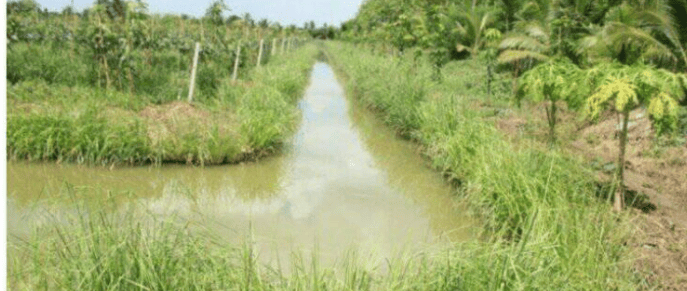
Vetiver stabilizes canal banks, dikes and levees, including salty ones in low coastal areas. Planted on the land side, it stops erosion when floodwater overtops the bank; along the crest, it makes a living edge where the top is used as a road. In the Mekong Delta, farmers find it also helps dry out the top of banks and reduces settling. It can also protect the raised flood and storm refuges built along flood barriers.


Dams and ponds
Small earth dams are most at risk on the wall and at the spillway during floods. Vetiver on the dam wall reduces damage from waves running up the face, and it protects spillways, often the weakest part of a dam. Because vetiver survives being under water for long periods, it can protect reservoir drawdown zones where the water level rises and falls, as on the Danjiang reservoir in China.
Around farm ponds, vetiver stops bank erosion and silting, shades fish near the banks, and gives cover to wildlife.


Drains and channels
On drains, vetiver stabilizes the sides, stops soil washing in, and shades out weeds, which cuts maintenance. A farm drain design by Jano Labat in Zimbabwe uses a low row of vetiver that lets water flow freely and protects the bed at full flow, and upper rows that stop the banks collapsing and keep sediment from roads and fields out of the drain. The same approach works on small irrigation channels.
On house plots in towns, vetiver can treat mixed household drainage before it reaches the public drain.

Design guidance: C7 GUIDE – RESIDENTIAL PLOT DRAINAGEDesign guidance: C8 GUIDE-RAW-SEWAGE-DRAINS
Further reading
Photo essays, papers and theses on vetiver for watersheds, banks, dikes and dams. Type in the search box to filter by topic, country or author. More papers are in the Document Center and the Conference Papers.