Bangladesh Moves Toward National Adoption of Vetiver
The most significant vetiver news comes from Bangladesh, where vetiver (locally “binna” grass) has moved from pilot projects to the top of government. On August 6, Prime Minister Tarique Rahman chaired a meeting at the Cabinet Division on using vetiver to protect riverbanks and canal embankments. Following encouraging results from pilot sites, he directed ministries and agencies to take the steps needed to use vetiver to protect rivers, canals, embankments, and transport infrastructure.
The case was made by Dr. Mohammad Shariful Islam of the Bangladesh University of Engineering and Technology (BUET), where he is Pro-Vice Chancellor and a professor of civil engineering. He presented vetiver as a durable, low-cost alternative to concrete blocks and geo-blocks for riverbanks, canal embankments, coastal dykes, roads in char and haor areas, and road and railway embankments. Dr. Shariful is well known to the vetiver community. He has received a number of prestigious vetiver awards, including recognition as a “Vetiver Champion” at ICV-7 in 2023, and he is the author of Standard Specification for Slope Stabilization Using Vetiver Grass,” a book focused on Bangladesh that is now listed as a reference in the TVNI Design Standards package. It is hard to imagine a better-qualified advocate.
Momentum has continued. On August 16, at a meeting on a “Vetiver Grass Policy for Bangladesh,” Water Resources Minister Shahid Uddin Chowdhury Anee described vetiver as an effective, environmentally friendly, low-cost solution to river erosion, soil erosion, and land degradation. The State Minister added that nature-based solutions must be given importance rather than relying solely on concrete. On August 17, a second meeting chaired by the Prime Minister agreed to form a technical committee to identify specific road and embankment projects. That committee was formally established on September 5. It has 34 members, including eight state ministers and 16 secretaries, and is led by the Prime Minister’s Finance and Planning Adviser, Rashed Al Mahmud Titumir. Its terms of reference include technical feasibility and cost per kilometer of planting along roads, highways, riverbanks, canals, haors, and embankments, as well as applications in the three hill districts.
Very few countries have gone this far. The committee’s questions on design, spacing, cost, and specifications are exactly the questions the TVNI VGT Guides and Design Standards were written to answer, and TVNI stands ready to support Dr. Shariful and his colleagues as the program moves from policy to practice.
Sources: The Daily Star (Aug 6); BSS (Aug 16); BSS (Aug 17); The Daily Star (34-member committee)
News From Around the Network
India: Central Railway Pilots Vetiver on the Western Ghats
India’s Central Railway is piloting vetiver bioengineering on its two most difficult mountain sections, the Bhor Ghat (Karjat–Lonavala) and Thal Ghat (Kasara–Igatpuri), which suffer from erosion, boulder falls, and shallow landslides every monsoon. Pilot plantings are still small, about 1,050 m² on the Khandala–Monkey Hill section and 4,250 m² between Thakurwadi Cabin and Palasdhari, but the design approach is correct: hedges on the contour across cut slopes and embankments, slowing runoff, trapping silt, and over time building natural terraces. Central Railway joins the Konkan Railway as an Indian rail operator using vetiver, and we hope these pilots expand quickly.
Source: NE India Broadcast (Aug 30)
Kenya: Vetiver in a County Watershed Program
In Kakamega County, the National Agricultural Value Chain Development Project (NAVCDP) has distributed Hass avocado, tissue-culture banana, and vetiver planting material to 432 farmers in the 944-hectare Nzoia Watershed in Likuyani Sub-County. The program combines terracing, agroforestry, and farm ponds, with vetiver used to stabilize the terraces. County officials stressed that the terraces must be maintained if the investment is to last, a point we strongly endorse: vetiver hedges, once established, are the lowest-maintenance way to protect a terrace. It is encouraging to see vetiver written into a government watershed program rather than a standalone NGO effort.
(Kenya Vetiver Network members should contact Kakamega County officials responsible for NAVCDP and explain to them that vetiver has many more benefits and applications than just stabilizing terraces. Vetiver can be used for fish pond stabilization and water clean up, can reduce root knot nematode incidence in avocado and banana. Refer them to TVNI Design Standards and Guides..ed)
Source: Talk Africa (Sept 3)
Briefly Noted
Eswatini. With a strong El Niño forecast, the Times of Eswatini has urged farmers to plant deep-rooted vetiver along contour lines to filter sediment, prevent gullying, and anchor topsoil. It is good to see vetiver in mainstream extension advice. We would add one note: vetiver hedges do not need dug contour trenches. A well-established hedge builds its own terrace.
Source: Times of Eswatini (Sept 23)
Thailand. A Chiang Rai Times feature on climate adaptation lists vetiver strips among the measures hill farmers are using to limit erosion on steep land, alongside mulch, water storage, and crop diversification. The article cites reductions in soil loss of up to 60%, though without a source.
Source: Chiang Rai Times (Aug 24)
Nigeria. The Alimat Care Foundation has completed a 12-month pilot in Gella community, Mubi South, Adamawa State, funded by the UNDP-GEF Small Grants Programme. The project introduced vetiver to stabilize erosion-prone land, combined with solar-powered dry-season irrigation.
Source: EnviroNews Nigeria (July 27)
Vietnam. A profile from Ninh Binh province tells the story of Nguyen Thi Hoai, who founded a vetiver incense business after learning about the plant at a landslide-prevention workshop. For every box of incense sold, she plants another vetiver plant in landslide-prone areas, and hundreds of thousands of plants have gone to La Pan Tan in Mu Cang Chai. It is another example of a woman-led vetiver enterprise in Vietnam (see OlaFarm below).
Source: Vietnam.vn
Latin America. The regional press has been quiet on vetiver this quarter, which we suspect reflects media coverage more than activity on the ground. We have asked our Latin American coordinators for news and will report in October. Meanwhile, El Niño is hitting the Central American Dry Corridor hard, with Guatemala alone projecting 3.2 million people in acute food insecurity. Hillside smallholders there are exactly the farmers who stand to gain most from vetiver’s moisture-conservation benefits, and GVF is now seeking partners in the region (see below).
Source: The Rio Times (Aug 12)
The VGT Design Standards and Guides: Revision Completed
The revision of the TVNI VGT Global Design Standards and Guides is now complete, with the package reissued and updated as on September 28, 2026. It is a suite of generic standards and guides grounded in research, long-term field experience, and, where applicable, current engineering practice. Its purpose is to bring consistency to a technology that has spread worldwide: to give practitioners design and implementation guidance, to help agencies, consultants, and contractors prepare contract-ready documentation, and to set minimum technical requirements for design, plant material, installation, and quality assurance.
More than 30 modules are grouped in four domains: A, water and hydrological protection; B, slopes, earthworks, and geotechnical stability; C, wastewater, effluent, and pollution control; and D, livelihoods, products, and community systems. New in this edition are “start here” documents on vetiver hedge mechanisms and on vetiver and water, a decision guide on when to plant a hedge versus stand-alone plants, and new modules including landslip repair, pit latrines, raw sewage drains, floriculture effluent, plant quality, and nursery management. A “choosing a module” table lets users start from their problem rather than from the domain.
It is important to understand the difference between the three designations each module carries. A GUIDE is our best estimate drawn from field practice for applications that are not yet advanced enough to be a standard. A Design Standard (DS) covers applications where measured and demonstrated results allow strict design parameters to be set. A Specification (SPEC) is a contract and bidding document, issued only for DS modules, covering problem definition, performance objectives, design criteria, layout, materials, installation, maintenance, failure modes, and monitoring. In short, guides advise, standards set requirements, and specifications turn those requirements into something that can be tendered, inspected, and paid for. A site that needs a contract specification is, by definition, a DS site. Specifications are currently available for water margins and watercourse banks (A1), farm soil and water conservation (A5/D3), engineered slopes (B1), landfills (C5), and rain gardens (C6).
The standards are deliberately generic and should be adapted to local soils, climate, hydrology, and regulation rather than applied rigidly. They will continue to evolve, and we welcome feedback, case studies, and corrections. Contradicting field evidence is as welcome as corroborating evidence, and often more useful.
Source: VGT Global Design Standards and Guides, vetiver.org
OlaFarm, Vietnam: A Model Vetiver Service Company in the Making
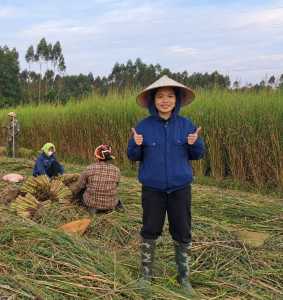
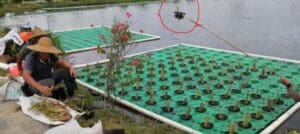
OlaFarm is a Vietnamese vetiver company based at a 6-hectare nursery in Quang Trung commune, Bac Ninh Province, just north of Hanoi. It is owned and run by Nhan Pham, MSc, an exceptionally capable manager who has built the business from a nursery into a company that supplies, advises on, and increasingly delivers Vetiver System applications across the country. OlaFarm, a woman-managed company from top to bottom, has supplied planting material to more than 600 projects in about 30 provinces, covering slope and landslide protection, soil improvement, pollution control, and agriculture, and it can harvest around 80,000 plants a day when demand requires. Its recent work includes planting material and design advice for vetiver floating rafts on a petrochemical refinery wastewater lagoon in Thanh Hoa Province (see attached very interesting and useful TVNI review note: Vetiver Floating Rafts for Oil Refinery Effluent, Thanh Hoa, Vietnam), where OlaFarm has agreed to run a year-long monitoring program to TVNI protocols. Nhan Pham is also the owner and founder of Herbbank (herbbank.vn), an aromatherapy
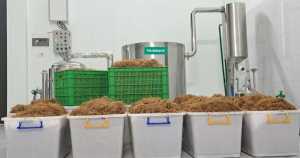
company at the same Bac Ninh site. Herbbank grows and distills its own vetiver root, alongside other Vietnamese aromatic plants, into pure essential oils, hydrosols, diffuser blends and incense. It also offers scent design, product development and contract manufacturing for other brands, and premium corporate gift lines, with staff trained to international clinical aromatherapy standards (NAHA in the United States and CFA in Canada).
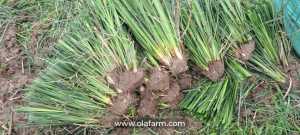
The foundation of the business is planting material of known identity and consistent quality. OlaFarm grows three named, sterile, non-invasive cultivars: Monto (from Australia), Songkhla 3 (a soft-leaved Thai line), and HB06, its own selection. It supplies them in whatever form a project needs: bare-root slips, clumps split to order at 2 to 10 tillers, nursery-bagged plants, and pre-grown vetiver strips. TVNI has seen the quality at first hand. For the Thanh Hoa installation, 108,000 tillers were split into uniform clumps of about 10, trimmed and packed so that the entire order traveled on a single 2.4-tonne truck, and they established vigorously in refinery effluent within weeks
What OlaFarm lacks to become a full Vetiver Service Company (VSC) is a development wing: the capacity to design, install, and maintain vetiver systems for clients in agriculture, infrastructure, and water treatment. That work is already beginning. As mentioned above OlaFarm is running a floating vetiver raft trial on a refinery lagoon in Thanh Hoa and hopes to test, with TVNI protocols, whether the nursery soil retained around each planted clump carries mycorrhizal fungi that speed establishment. With a development wing in place, OlaFarm could become a regional reference point for the VSC model, and we believe it may prove to be “gold” for vetiver in Southeast Asia. See olafarm.com
OlaFarm is listed in TVNI’s Global Vetiver Grass Plant Suppliers directory for Vietnam.
GVF: The Global Vetiver Farmer Program Moves Ahead
The second meeting of the Global Vetiver Farmer Demonstration-Trial Program (GVF) was held on Zoom on September 27, with 28 participants from Ethiopia, Kenya, Tanzania, India, and the United States. The meeting agreed to move ahead with a simplified two-level structure and to begin field activities within the next 12 months, aligned with local cropping seasons.
The core decision was to freeze and publish the observation forms. SVH-1 is a citizen-science form that farmers complete, ideally once a year at harvest, recording what they see around their vetiver hedges and plants. SVH-2 is an add-on for research institutions, which will take the scientific measurements, such as mycorrhizal activity in the shared root zone, needed to explain why farmers see the improvements they report. The seven GVF farm models (V101, V101E, V48, VCR, VFF, VPGS, and Kitchen Garden) will be retained and reissued with fact sheets.
Country teams reported encouraging progress. In Ethiopia, Alemu Mekonnen and Lata Hailu surveyed vetiver in coffee-growing regions and will visit old vetiver sites at Metu; Leta Hailu of the Jimma Agricultural Research Center expressed support for the SVH approach. In Kenya, Peter Kingori of Reclaim Your Soil with Vetiver will establish demonstration sites for each GVF model in Central Kenya, including school gardens. In India, Sara Ibrahim reported that Tamil Nadu Agricultural University trials cover cassava in Salem district (2 acres, expanding to 5), coffee (including carbon sequestration), and dragon fruit. Partnerships are being explored in Sri Lanka (University of Peradeniya), with IRRI, and in Mesoamerica through Jim Smyle, who has also offered up to US$1,000 to help unfunded coordinators get started.
Test translations have shown that the GVF materials can be made available in most languages, and we will initially provide Swahili, Oromifa, Amharic, Tamil, Spanish, Mandarin, and Vietnamese. We should be clear about expectations: unless farmers are working with older, established hedges, significant results should not be expected in the first year. The next GVF meeting is scheduled for January 2027.
GVF belongs to its participants. They will manage it, and they and their farmers reap the benefits; TVNI is the messenger, the prodder, and the collector of the information we will feed back to every node. A further post in October will make the full GVF package, including the handbook, forms, and farm model fact sheets, available to the public. We warmly invite anyone with vetiver hedges or plants, including retirees, volunteers, and school groups, to take part.
New Technical Notes on Crop Enterprises
TVNI has prepared two short notes this month on how vetiver relates to specific farm enterprises. We hope to add further notes on other crops and topics as interest arises, so please tell us which enterprises matter most to you.
Vetiver Forage Management
Vetiver makes acceptable-to-good forage if harvested young and poor forage if left to mature: protein, minerals, and palatability fall with age while fiber rises. The key management decision is the cutting interval, which involves a real trade-off. Cutting every two to four weeks gives the best feed quality and intake, while longer intervals give more biomass and much stronger roots. The note’s practical rule is that on contour hedges and slope protection, the longer interval (about three months, with leaves 60–80 cm long) should be used and forage treated as a by-product; dedicated fodder rows on safe ground can be cut every three to six weeks with manure or fertilizer to support the stand. The note also covers cutting height (leave about 20 cm), soil fertility, plant density, season, feeding (fresh, young, chopped, and mixed with legumes), and a caution that a new soft-leaved line reported in Vietnam should be tested before it is promoted. It complements Design Standards module D8, Forage Management of Vetiver Grass.
Reference:
NOTE – TVNI. Vetiver Forage Management: Management Guidance for Cut-and-Carry and Grazing. September 2026.
GUIDE:Vetiver as Forage and its Management
How Vetiver Benefits Dragon Fruit
Dragon fruit (pitaya) has a shallow root system, rots under waterlogging, is heavily fertilized, and is a good host of root-knot nematodes. Each of these weaknesses lines up with something vetiver does well. The note groups the benefits into six areas: dry-season soil moisture, nematode suppression, erosion and drainage control, mulch, mycorrhizal support, and capture of nutrient and agrochemical runoff. It is candid about the evidence. The general vetiver mechanisms are well established, but dragon-fruit-specific data are thin, consisting of one reported Vietnamese trial on soil moisture and farmer observations. Nematode suppression is inferred rather than shown, and it should not be assumed where the resistance-breaking species Meloidogyne enterolobii dominates. The note closes with practical layout advice (hedges in full sun, trimmed to about 50 cm, a meter or more from the posts) and proposes a simple paired on-farm trial to close the evidence gap. It is timely, since the GVF team in Tamil Nadu is now recruiting dragon fruit farmers for demonstrations.
Reference: TVNI. How Vetiver Benefits Dragon Fruit: Mechanisms, Strength of Evidence, and Practical Layout Notes. September 2026.
Ethiopia: Two Seasons and Thirty Years
In reviewing vetiver related research in Ethiopia we came across some interesting research papers that may help to unravel some of the mysteries relating to vetiver’s many biological benefits. We found some interesting aspects that deserve further research investigations that should be of interest to farmers in Ethiopia and in other regions. The work of the Ethiopian researchers was under- recognised and I hope that the following notes may bring greater rectify that fact and the potential it may unleash.
The Gibe Kabala Hedgerow Demonstration
TVNI has sent a collegial review note to the Ethiopian team behind “Large-scale Demonstration of Vetiver Grass Hedgerows in Gibe-Kabala Watershed,” researchers from the Jimma and Wolkite Agricultural Research Centers. It is the most substantial Ethiopian field evidence on vetiver hedgerows we have seen in years: 33.5 hectares, 60 farmers, two seasons, measured sediment deposition of about 46 tonnes per hectare per year, soil chemistry at three depths, and maize and tef yields reported 67% and 52% higher than on untreated fields. Topsoil organic carbon rose from 1.57% to 2.28%, and nearly 600 people, 120 of them women, attended the field days.
The most interesting result is one the paper passes over. Available phosphorus rose not only in the topsoil, where reduced erosion and better organic matter cycling explain it, but also at 20–40 cm, where neither explanation works well. That is the zone where vetiver roots are dense, crop roots are sparse, and almost no surface organic matter arrives. Soil pH rose at all three depths, yet phosphorus rose only in the two upper layers and was flat at 40–60 cm. If the gain were simply a pH effect, phosphorus should have followed pH all the way down; instead it follows vetiver root density. That points toward root-zone biology, especially vetiver’s arbuscular mycorrhizal fungi (AMF), as a possible cause. No mycorrhizal measurements were taken, so this remains a hypothesis, and sampling position (whether buried topsoil was included in the deeper samples) must be ruled out first. But it is exactly the kind of testable signal the GVF SVH-2 research component is designed to follow up.
The review also sets out five mechanisms that could together explain the large yield gains: spreading of runoff as an even sheet below each hedge, mycorrhizal nutrition, stem borer trapping in maize, nematode suppression, and the extra attention participating farmers received. Because each leaves a different spatial fingerprint, TVNI has proposed sampling along transects running from one hedge to the next on the existing plots, which could separate them at very little cost.
Anno Agro Industry Farm: Vetiver After Thirty Years
TVNI has also reviewed an older Ethiopian paper that makes an ideal companion to Gibe Kabala. At Anno Agro Industry Farm in Gobu Sayo District, Oromia, the investors found terraces expensive, space-consuming, and prone to destruction by runoff on steeper ground, so in 1995 they chose vetiver instead, with no project paying for it. Gesesse and colleagues (2013) sampled soil under hedges about sixteen years old and compared it with adjacent unprotected land. Satellite imagery dated January 14, 2025, shows the hedges still intact some thirty years after planting began, and neighboring smallholder farms appear to carry contour hedges of their own. If ground checks confirm that those are vetiver and that they followed the farm’s example, Anno is a case of farmer-to-farmer spread sustained for decades without any extension program. Where Gibe Kabala shows that smallholders will take up the system and see results, Anno shows that it lasts after the project is gone, and here there never was a project.
The paper also included a greenhouse pot trial, growing maize in soil from both areas under identical conditions. Maize root weight was about 21% higher in the vetiver soil, and shoot weight roughly a third higher. Because a pot trial removes farmer management, water movement, and pests, this is the first Ethiopian evidence that a substantial part of the vetiver advantage lies in the soil itself and is not simply the result of extra attention to demonstration farmers.
The most interesting finding concerns nitrogen. Total nitrogen was about a third higher under vetiver (0.32% against 0.24%). The authors attribute this to more organic matter and less erosion, but the TVNI review suggests a further possible reason. Flume studies by the USDA in the 1990s showed that vetiver hedges trap more than 90% of coarse sediment but only about a fifth of the finest particles. What passes through a hedge is therefore mostly clay, fine silt, and fine organic matter, the fraction in which soil nitrogen, phosphorus, and nutrient-holding capacity are concentrated. Without hedges, that material leaves the field in rills. With hedges, it is released below each hedge as a broad, slow sheet of water and spread across the strip, where much of it soaks in. Over many years this could raise nitrogen across the whole field between hedges, not just in the silt wedge above each one. It is the fertility counterpart of vetiver’s water-spreading effect. The Anno data offer some indirect support: nutrient-holding capacity (CEC) rose by more than the organic matter gain can explain, which suggests the soil has been enriched with clay. This remains a hypothesis. Tillage moving topsoil downhill against the hedges, vetiver litter and roots, and differences in fertilizer history could all contribute, and each leaves a different pattern that sampling across the strip between hedges would reveal.
TVNI is proposing that Anno become the mature end of a comparison with Gibe Kabala, running the same measurements on a two-year and a thirty-year vetiver system in comparable country, along with a simple pot trial using sterilized and live soil to test whether part of the vetiver effect is biological. A dated satellite record of when the neighboring smallholder hedges first appeared would show how far adoption has spread from the farm.
References: Gesesse, A., Balemi, T., Natarajan, P., and Amha, Y. (2013). Effect of vetiver grass hedges in maintaining soil fertility and productivity at Anno Agro Industry Farm, Gobu Sayo District, Oromia Region, Ethiopia. Journal of Science and Sustainable Development 1(1): 37–49, Ambo University. TVNI. Notes on the Anno Agro Industry Farm Vetiver Paper, Read Alongside Gibe Kabala. September 2026. Meyer, L.D., Dabney, S.M., and Harmon, W.C. (1995). Sediment-trapping effectiveness of stiff-grass hedges. Transactions of the ASAE 38(3): 809–815.
Farewell to Feng Ziyuan
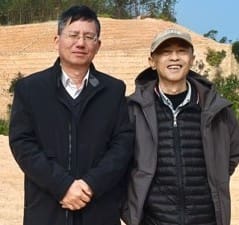
It is with great sadness that we report the death earlier this month of Feng Ziyuan of China. Over 25 years, Feng built a successful Vetiver Service Company, Guangzhou City Vetiver Grass Industry Science Co. LTD, and proved, long before most of us were using the term, that vetiver could be a sound business as well as a sound technology. He contributed greatly to vetiver bioengineering and to phytoremediation applications, and he generously shared his knowledge with the network, most recently helping TVNI with developing TVNI’s Guides and standards. Over the years his work was recognized with many awards, including the King of Thailand’s Vetiver Award. In 2025 he visited Tanzania and saw the potential there and elsewhere in eastern Africa for vetiver in the construction of infrastructure (some based on significant Chinese investments). Prior to his death he was in the process of establishing a Vetiver Service Company there to introduce high quality vetiver technology and the involvement and training of small African companies to service infrastructure programs at levels of quality and efficiency.
Feng will be greatly missed by his colleagues and friends around the world. His greater goal was to see vetiver used as a significant global environmental tool for the good — and we will continue to work toward it. On behalf of the whole vetiver community, we extend our deepest condolences to his wife and family.
Dick Grimshaw
please add me to your mailing list