The Hedge That Pays Twice
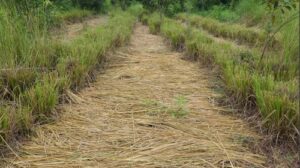 How vetiver grass and its mulch cut farm costs and keep crops alive when the weather turns extreme
Ask any farmer what has changed in the last decade and you will hear the same answer on every continent: the weather no longer behaves. Rains arrive late, then fall all at once. Dry spells stretch two weeks longer than they used to. Soil that took generations to build washes away in a single afternoon storm. Fertilizer, fuel, and labor cost more every season, while the harvest they are supposed to protect gets less certain.
There is a tool for this, and it is not a machine or a bag of chemicals. It is a grass. Vetiver (Chrysopogon zizanioides) has been planted as contour hedgerows against erosion for decades across Asia, Africa, and Latin America. It is sterile, so it never spreads as a weed; its roots drive straight down two to three meters, so it never competes sideways with crops; and once established it survives drought, fire, flooding, and neglect. Most farmers who plant it think of it as a fence against erosion. That is only half the story. A well-managed vetiver hedge is also a biomass factory — and the biomass is the second harvest.
The second harvest: mulch you grow instead of buy
A vetiver hedge needs cutting anyway — pruned back to knee height every two to three months, it stays dense at the base and does its erosion-control job better. Each cut yields an armful of long, tough leaves per meter of hedge: over a year, on the order of two to five kilograms of dry material per meter. A smallholding contoured with a few hundred meters of hedgerow produces several tonnes of mulch annually, every year, from land the crops were not using — the hedge lines that were already there designed to stop erosion.
Compare that with what the same farm can produce in manure. A household with two or three animals collects one or two tonnes a year, and that manure has other claimants — the home garden, biogas, other fuel, sometimes sale. Purchased mulch or plastic sheeting costs cash and, in the case of plastic, has a disposal problem. The vetiver hedge produces mulch at the cost of the labor to cut and carry it a few meters. And unlike manure or brought-in straw, vetiver mulch carries essentially no weed seed, because the plant itself sets none. You are not importing next season’s weeding bill along with this season’s soil cover.
What the mulch does when the weather goes wrong
In a heat wave and drought, a hand-thick blanket of vetiver leaves between crop rows shades the soil surface, cuts evaporation dramatically, and keeps root-zone temperatures down. Grape growers in the driest parts of northern Vietnam mulch with vetiver specifically to reduce how much irrigation water they must supply; coffee estates in Ethiopia have mulched with vetiver for fifty years for the same reason. When the rains stall for three weeks, the mulched field is still holding moisture the bare field lost in the first five days.
In a downpour, the same blanket works in reverse. Raindrops on bare tropical soil strike like tiny hammers, sealing the surface so that water runs off instead of soaking in — taking topsoil with it. Mulch absorbs that impact. Field research in West Africa found soil under vetiver mulch had the lowest erodibility of any treatment tested, and the combination that farmers actually use — a vetiver hedge on the contour with the prunings spread between the rows — attacks the problem from both ends: the mulch stops most soil from being dislodged, and the hedge traps whatever moves anyway, ponding the runoff so it soaks in on the field instead of leaving it. Water that would have been a destructive flood becomes stored soil moisture for the dry weeks that follow.
Because vetiver leaf is tough and slow to rot — it is one of the most lignin-rich grasses there is — the blanket lasts months, not weeks, before it finally breaks down and feeds the soil. That slow decay is a feature twice over: long-lasting protection first, then a steady trickle of nutrients and organic matter afterward. Soils under sustained vetiver mulching show measurably better structure, more stable aggregates, higher organic matter, and more biological life. In the drylands, even the termites that eventually eat the dry leaves are doing useful work: their tunneling breaks surface crusts and opens the soil so the next rain infiltrates instead of running off.
What it saves
Count the line items the hedge-plus-mulch system quietly removes or shrinks. Weeding labor or herbicide: a thick vetiver mulch suppresses weed emergence for months. Irrigation: less evaporation means fewer waterings to reach the same result. Fertilizer: the decomposing mulch returns potassium quickly and nitrogen and phosphorus steadily, and the improved soil holds what you do apply instead of letting it wash away. Manure: scarce farmyard manure goes two or three times further when it is concentrated in planting holes and seedbeds while vetiver mulch covers the open ground — farmers in Vietnam protecting young cacao found that half the usual manure dose, combined with composted vetiver, grew bigger seedlings than the full dose alone. Replanting: the largest hidden cost of extreme weather is the crop you lose entirely; a field that keeps its moisture through the dry spell and keeps its soil through the storm is a field you do not plant twice.
None of this requires buying anything after the first planting material. The hedge, once established, is effectively permanent — hedges planted in the 1980s are still working today — and every year of pruning is another year of free mulch.
How to do it: five rules from the field
Plant on the contour and close. Set slips a hand-width apart (10–15 cm) along the contour line so the hedge closes into a tight wall within a year or two. On sloping land, space hedge lines so each protects the strip below it — steeper land, closer lines.
Cut early, cut often. Prune to 30–50 cm every two to three months once established. Frequent cutting keeps the hedge dense at ground level — which is what stops runoff — and keeps the mulch supply coming in manageable amounts.
Chop and drop where the crop is. Lay the cut leaves between crop rows, around fruit trees (clear of the trunk), and over any bare ground, aiming for a layer thick enough to hide the soil. There is no need to compost it first for field use — composting costs two to three times the handling labor and burns off a third to half of the material before it ever reaches the field. Let the field do the composting.
In termite country, mind the placement. Dry vetiver leaf is termite food — useful in the open inter-row, where it diverts termites from the crop and feeds the soil, but not against the stem of a young tree or seedling. Vetiver’s famous termite resistance lives in the living root, not the dead leaf: farmers in Senegal find fences and trees ringed with growing vetiver left alone while unprotected ones are eaten. So for vulnerable seedlings, do what the Vietnamese cacao growers did — plant a ring of live vetiver clumps around the young plant and keep the loose dry mulch a step away.
Save composting for where form matters. Nursery mixes, vegetable seedbeds, and planting holes are the places a fine, concentrated compost beats a coarse mulch — and vetiver compost blended with a little manure is excellent there. Everywhere else, the uncomposted leaf on the surface does more work for less labor.
Reliability is the real crop
Yield trials make headlines when a treatment adds a few hundred kilograms per hectare in a good year. But smallholder livelihoods are not broken by slightly smaller harvests in good years; they are broken by the catastrophic year — the failed stand, the washed-out field, the dry spell that hits at flowering. The hedge-and-mulch system is aimed squarely at that: it narrows the gap between your best year and your worst one. Researchers in Nigeria who compared vetiver systems on badly eroded land found, unsurprisingly, that hedges alone protect the soil but cannot rebuild its fertility — it is the returned biomass, as mulch, that rebuilds soil quality while the hedge stands guard. The hedge is the engine; the mulch is what the engine produces. Farmers who use both are not buying a yield boost. They are buying certainty — with labor they control, from a grass that asks for nothing back.
For planting material, hedge design guidance, the technical evidence behind this article, and all Vetiver System Applications visit The Vetiver Network International at http://www.vetiver.org and specifically