Updated Design Standards and Specifications
What the revisions mean for your work
The design standards, guides and specifications listed in the design spec table are there to support your work with vetiver — whether you use them as an individual, as a company, or as an organization providing vetiver services.
The early versions of some of these standards were not tight designs backed by verified information. Since June of this year I have been revising them — not all of them yet, but a good many — and the revised versions are considerably tighter. Each design is now set against what can be determined as accurate: research data, documented project reports, case studies, and feedback from the field. Where the vetiver data themselves are thin, we have in places drawn on species whose biology closely parallels vetiver’s and inferred that the same characteristics carry across into a vetiver design. Those inferences are reasoned but not fully tested, and they are marked as such in the documents, so you can always see which parts of a design rest on measurement and which rest on judgment.
The attached table lists the most recent revisions. I believe they (together with standards yet to be revised before the end of this year) now provide a sound basis for serious and effective design work with vetiver, both in the agricultural sector and in bio-engineering and pollution control. If you already run a vetiver-based business, or want to start one, these documents — and the links to them on our website — give you something solid to build a company on. Between them they cover on-farm infrastructure; public infrastructure such as roads, railways and waterways; wastewater treatment; and stormwater runoff control. You can put them in front of a design engineer with a fair degree of confidence: the standards themselves, and the contract specifications that accompany some of them.
One thing does not change, whichever standard you use and whether or not you modify it. The result will depend on three things: the quality of the planting material, the quality of the design/application, and the quality of the maintenance. Get all three right, at the highest level, and the outcome should satisfy every party to the work. Get any one of them wrong and no standard will rescue the design.
There is a genuine business opportunity in this, and one that could grow into something significant — vetiver eco-engineering and eco-farming at its best.
The Vetiver Service Company – Can it be built on solid design standards
The updated design standards do two separate jobs, and it is worth being clear about the difference because it is the difference on which a vetiver service company can be built.
A standard says what correct looks like. Its companion specification says what acceptable looks like — measured, at a stated date, against stated tolerances. The first is what you sell as advice. The second is what you deliver against, and get paid on. A company organized in two wings, development and retail, has one wing on each side of that line.
The development wing: training, technical audit, design
This wing sells judgment. Its stock in trade is that its advice is traceable to a published document rather than to the confidence of the person giving it. Three points make that possible.
- The mechanisms standard and the water foundation note give the wing a defensible technical story — why vetiver works, water management first and erosion control following from it. That is what a client’s engineer will interrogate, and it is now answerable.
- Every design figure carries an evidence tag, so the wing can tell a client which numbers are measured, which are derived, and which are inferred from analogous species. Saying so openly is worth more in front of a professional engineer than claiming certainty and being caught out.
- Reading a standard against its specification turns audit into a defined service. The auditor is not offering a view; they are reporting whether stated criteria were met.
| Function | Documents it runs on | What it lets the company sell |
| Design | DS-WATER-MARGINS + spec; DS-ENGINEERED-SLOPES + spec; DS-RAINGARDEN + spec; DS-ON-FARM-SWC + spec; DS-FLOATING-ISLANDS; DS-VFI-FISH; DS-VERTISOL-AGRICULTURE; VGT-RESIDENTIAL-PLOT-DRAINAGE | Priced design work for farms, roads, railways, waterways, dams, stormwater and wastewater schemes — drawn to a published standard rather than to opinion |
| Training | DS-VETIVER-MECHANISMS; VGT Water Foundation; DS-COMPARE-SPECIES; stem borer, nematode and AMF guides; DS-SOIL-CARBON; DS-FORAGE | A ready curriculum with a defensible evidence base — courses for engineers, extension staff, NGOs and government clients |
| Technical audit | The design standards read against their companion specifications; the evidence tags in each standard | Independent review of other people’s vetiver work — including, in time, of other VSCs — reporting what was specified, what was installed, and what it can be expected to do |
| Program delivery | The whole suite, plus the specifications as the payment instrument | Prime contracts to design, staff and run smallholder and community programs end to end for NGOs, donors and local government |
The development wing as prime contractor
The fourth row above is the largest of them, and it deserves its own explanation. A properly staffed VSC can contract to develop and execute a smallholder or community vetiver program in its entirety — for an international NGO, a local NGO, a donor project or a local government — rather than selling those bodies a design and leaving them to find someone to build it.
The gap this fills is real and it is not primarily technical. Most NGOs and district authorities can find someone who knows what vetiver is. What they cannot readily find is an organization that can produce the planting material to grade, in quantity, on the date it is needed; supervise crews across scattered smallholdings; train and certify local contractors as it goes; and account for all of it to a donor’s reporting standard. That is management capacity, and it is exactly what a VSC with both wings already has to have in order to function at all.
In this mode the development wing is the prime contractor and both wings are its delivery arms: design, training and supervision from development; nursery output, installation and crew certification from retail. Structuring it this way matters. If program work is treated as a development-wing service alone, nursery capacity and field crews get planned as an afterthought, and those are precisely the two things the client cannot supply for itself.
Paying on performance — and what the company is actually selling
Nearly every NGO and government agriculture/forestry contract I have seen pays on activity: slips/seedlings supplied, farmers trained, kilometers planted. The failure that follows is familiar to anyone who has watched these programs. The company trains the farmers, perhaps provides the planting material, and then does nothing further. The farmers walk away, or they plant incorrectly, get no benefit from it, and lose interest. Three years later there is little on the ground to show for the money. Almost every disappointing smallholder program I know of has had that shape.
On a smallholder program the farmer supplies the labor. The company is therefore not selling installation at all — it is selling supervision and completion. Its product is that the hedge is on the contour, planted at the correct spacing, gapped up where plants have died, and working at the end of the first year. That is squarely within the company’s control and it is the right thing for it to be paid for. It is worth being clear on this point: a company can properly be held to the first-year result, even though it cannot be held to a farmer’s maintenance behavior indefinitely.
Paying at 12 months against the condition of the hedge, rather than against slips delivered and farmers trained, forces the follow-up visits to happen. Those visits are always the first item cut from a program budget, because on paper they look like overhead rather than delivery; when payment depends on them they stop being optional. It also changes the bid unit. The company should be quoting per farmer, or per hectare, supervised to a verified standard — not per slip supplied or per training day run.
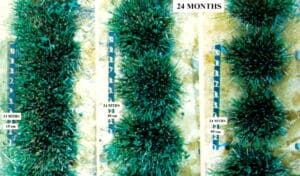
Write it as two tests rather than one. Our own design standard sets hedge completion — continuous and without gaps — at the end of 24 months, with planting at 10–15 cm centers so that the line still closes even if some plants die and are not replaced. A 12-month test therefore cannot be a no-gaps test. At 12 months the test should be: correct alignment on the contour, correct spacing at planting, survival above a stated percentage, a continuous working line, and gaps filled. Hold a retention against the 24-month closure test taken from the standard. After 24 months the hedge belongs to the farmer, and if the first two years have been done properly he will have good reason to keep it.
Two practical points will come up immediately in any negotiation. Performance payment means the company finances establishment out of its own working capital, which for a young VSC is usually the binding constraint — ask for a mobilization advance against the nursery build. And many donor and government procurement systems cannot actually execute outcome-based payment even when the program officer wants to; the workable form is a conventional milestone schedule with the acceptance tests written in as the release condition on the final payments.
One staffing observation. The role most often missing in a technically strong VSC is not agronomic. It is the person who can administer a contract and report to donor standard. A company with a good agronomist, a nursery manager and a works supervisor will still lose the bid, or lose money on it, without that fourth person.
Two kinds of audit — and who pays for each
Program work of this kind reopens the audit question in a sharper form. A company that designs a program, supplies the material, supervises the planting and then verifies its own outcomes will not be believed by any donor evaluation unit, and should not be. But there are two distinct kinds of audit at work here, and it is important not to merge them, because merging them destroys the more valuable of the two.
The first is audit for self-improvement — the plantation form. In Malaysia it is normal practice for one plantation house to pay another house of standing to audit its estates. I used the same approach in my World Bank work, and the visiting agents consistently identified many more issues than Bank staff did: they knew the crop, they had no stake in the report reading well, and they were on the ground often enough to see what a supervision mission does not. The outcome was very good. The essential feature is that the company commissions the audit, chooses the auditor, pays for it, and owns the report. It works precisely because it is private. The moment such a report is routed to a funder it becomes a compliance document, and the candor that gives it its value disappears.
The second is verification for the client or funder — confirmation that the contracted result was achieved, tied to release of payment. This is the client’s assurance instrument, not the contractor’s, and the client should procure it and pay for it. Whoever needs the assurance pays for it. An auditor whose fee comes from the party being audited will be discounted by any evaluation unit however sound the work, which defeats the object of appointing a third party at all; and loading the cost onto a young VSC bears directly on the working capital constraint noted above. The right place for it is a separate line in the program budget, which also has the merit of making the client fund verification deliberately rather than leaving it as someone’s overhead.
The contractor should carry one cost here: the re-test after a failed acceptance test. That is normal construction practice — the first test on the client, the re-test on the contractor if the works fail — and it puts the incentive in the right place without compromising the auditor’s independence.
Alongside that, the contractor is entitled to certain things: to be present at the inspection, to see the report in full, to contest findings on the record, and to a reasonable right of objection to the auditor appointed. That last point needs a conflict rule, because peer auditors in this industry will often be competitors. An auditor should not be bidding the follow-on phase of the program it is auditing, and preferably should not be trading in the same territory. Without such a rule, agreeing to be audited by another VSC amounts to inviting the company that wants your client to inspect your relationship with them.
The opportunity in all this is that as more VSCs come into being they become each other’s auditors, in both senses. Peer audit is a billable service between companies; it circulates good practice faster than any training course; and it gives the standards teeth that TVNI could never enforce from the outside. That is the visiting agent model, and I would like to see it become normal in the vetiver world.
The retail wing: material, application, audit, contractor training, products
This wing sells delivery, and the standards matter here in a more direct way: they convert quality into something that can be written into a contract and tested at handover. The three determinants of every vetiver outcome — quality of planting material, quality of application, quality of maintenance — now each have a document behind them, which means each can be specified, priced and inspected instead of hoped for.
Two of these deserve emphasis. Plant quality and nursery management, taken together, let the wing sell material on a published grade; that is the difference between a nursery and a certified supplier, and it is defensible on price. And payment tied to acceptance testing, rather than to installation, aligns the contractor with the client from the first day and is in my view the mechanism that makes commercial vetiver work sustainable.
| Function | Documents it runs on | What it lets the company sell |
| Plant material supply | DS-NURSERY-MANAGEMENT; DS-PLANT-QUALITY; DS-MICROBIAL-ROOT-DIP | Graded, certified planting material sold on a published grade rather than by the bundle — the single highest-margin line in the wing |
| Application | VGT Planting Guide; the relevant design standard; the matching contract specification | Installation contracts where scope, workmanship and payment points are already written down |
| Acceptance audit | The contract specifications (on-farm SWC, engineered slopes, water margins, rain gardens) | Acceptance testing at handover and at 12 and 24 months — billable, and it protects the client and the contractor equally |
| Contractor training | VGT Planting Guide; DS-PLANT-QUALITY; the specification for the works in hand | Certification of sub-contractors and crews, so the company can grow without diluting quality |
| Vetiver products | DS-FORAGE; Vetiver Mulch versus Veticompost; DS-KITCHEN-GARDEN | Revenue from the cut material: forage and drought reserve, mulch, compost, kitchen-garden packages |
Where the standards do not yet reach
The retail wing’s downstream product lines — pelletizing, thatching, fuel briquettes, handicrafts, essential oil — are not covered by any current standard. The forage and mulch documents deal with cutting regimes and biomass use for on-farm purposes; they do not address feedstock specification, moisture content, calorific value, fiber grading or the equipment and safety questions that a processing business runs into. Anyone building that side of the business should treat it as commercially promising but technically unsupported for now, and should not represent it as standard-based work.
This is a gap worth filling and I would welcome field data from anyone already processing vetiver biomass at any scale.
The shape of the opportunity
The three lines feed each other. Design and training generate specified work; program contracts put the company in charge of whole catchments and whole communities rather than single sites; and delivery produces the field evidence that sharpens the next revision of the standards. Common standards, common brand, local delivery, and companies auditing each other to keep the standard meaningful — much as a franchise operates, and that is deliberate.
The standards will not make a company competent. What they do is remove the argument about what competent means, and give a serious operator something to be measured against. That is the foundation on which a vetiver eco-engineering business can be built.