|
The good growth of Vetiver, under many adverse conditions, suggests it to be highly competitive. In a preliminary trial, Vetiver without regular slashing has been demonstrated to be competitive against Hevea; the girthing of the young Hevea was depressed. On the other hand, this growth characteristic can be exploited for various used as in situ source for mulch when the tops are regularly slashed. Six experiments were set up to test this in three estates. These trials are sited in three estates as follows:
The experimental details are:
RESULTS The results are now discussed below: The starting of this trial was reported in the First Progress Report. Photos 1-4 show the Vetiver clumps at field planting and the luxuriant hedgerows formed at 9, 15 and 44 weeks after planting. The Vetiver hedgerows establish very rapidly. Note the sparse legume covers in the Vetiver plots, but the Pueraria phaseoloides grows very well in the control plots. However later, the leguminous covers were shaded out by the Hevea canopy. Periodic measurements of Hevea plant girths and the increment derived are used as growth indicators. These are given in Table 1. Analysis using t-test suggests the effect of Vetiver mulches on Hevea growth to be non-significant at four months after treatment. At ten months, mulching has shown positive effect in one block out of three. Both in relation to girth and girth increment over six (4-10) months. Measurements at 17 months show Vetiver planting to be beneficial in the same block but detrimental to Hevea growth in the other two blocks. The girth increment between 10-17 months shows Vetiver planting to suppress the growth rate of Hevea in these tow blocks also. At 24 months, the Vetiver planting depresses the growth of Hevea; this is also shown in the girth increment between 17-14 months. The rounds of slashing of the Vetiver tips are as follows:
Because of labour constraint we were not able to carry out the schedule slashing at 2 – 2 ½ months intervals. The field conditions in this trial are illustrated in Photos 5 to 8. Photos 5 and 6 show the Vetiver circular planting of 18 inches and 24 inches radius at time of establishment. Photo 7 shows the Vetiver plot of 18 inches circular planting at 12 weeks with the plot of linear planted Vetiver in the lower terrace. Photo 8 was at 14 weeks after planting the Vetiver and two weeks after slashing of tops. The plot shown is circular planting of 24 inches, while linear planting is visible at the lower terrace. The girth measurements taken are summarised in Table 2. Vetiver planted at 18 inches round the Hevea plant depressed the girth of Hevea from the seventh month after planting. With the bigger radius of 24 inches, the depression only starts after 14 months. With growth rates measured by girth increment, linear planting of Vetiver was beneficial to Hevea growth between one to seven months while circular planting at 18 inches depressed the Hevea growth rates. The growth of Hevea between seven to fourteen and fourteen to twenty two months were similar for all treatments. The rounds of slashing the Vetiver tops are as follows:
Since Trials 1 & 2 are sited in the same estate, topping was done in the same month by the estate. The interval between the topping rounds are similar to Trial 1, except for Round 1 with a shorter duration of two months compared with five months in the earlier trial. This is on a very step hill. The Vetiver was established six months earlier than the Hevea. Photos 9 and 10 show the general view of the linear Vetiver hedgerows at various weeks after planting. Photos 11 and 12 show the condition when Hevea was just planted; the mulch is from Vetiver hedgerows already established. Photo 13 shows the partially decomposed state of the Vetiver mulch after an interval of three months. Even when we examined the plants at midday, the soil around the collar of the Hevea plant was still moist (Photo 14). The trial is too early for girth measurements. The trial continues. Photos 15 & 16 show the trial at planting of the Vetiver hedgerows. The demarcation between plots can be seen by the raffia string (® ) and extends down the slope of the hill. The plot size varies, depending on the number of planting rows. Girth measurements at 6, 14, and 18 months show that there is no difference between hevea plants in the Vetiver plots and the control plots Table 3. Also the girth increments at six to fourteen months and fourteen months and eighteen months are similar for both treatments. Photo 17 shows the experimental site. Photo 18 shows the Vetiver circular planting of 18 inches. Notice the rapid establishment of Vetiver plants at only four weeks after planting; this is a result of using good quality polybag plants prepared in the nursery. Table 4 summarises the girth measurements of the Hevea plants at three, 19 and 12 months and girth increments for the specific periods. There is no difference between the girth of the treated and control. Although control was superior at three to ten months, there is no difference of growth rates at ten to twelve months. Trial 6 sited on a steep hill of a different soil type. Photos 19 and 20 show the general view. Photos 21, 22, 23 and 24 show the various treatments at planting. Photos 25 and 26 show treatment (24 inches – 26 plants) at 19 and 28 weeks after planting. Notice the good growth of the Vetiver. Photos 27 and 28 show the general view of various treatments after five and 32 weeks respectively. Photos 29 and 30 show the stages of Vetiver growth at 28 and 44 weeks after planting; the Vetiver plants were growing well. However, there was a deliberate spraying of herbicides on the Vetiver plants at 58 weeks (Photo 31), mainly due to an unresolved industrial dispute. Fortunately, the Vetiver plant recovered remarkably well as shown in Photo 32, taken four weeks later. However the effect of this spraying may affect the outcome of the trial. The trial continues and growth of the Hevea plants will be closely monitored till the trees are opened for tapping (normally 5 years). The girth measurements and girth increments are summarised in Table 5. The close circular planting of 18 inches with 20 plants of Vetiver was suppressing the Hevea seedling growth from the seventh week and also the growth rates from seven to twelve and twelve to fourteen months. 18 inches circular planting with ten plants was just as suppressive except that the seedling girth at seven months was still similar to the control. Circular planting with 24 inches was slightly less suppressive to Hevea growth but still adversely affected the seedling girth at twelve and fourteen months and the girth increment at seven to twelve months. Linear planting of Vetiver hedgerow have the least suppressive effect on Hevea growth. The surprising result was that linear planting with polybag plants at twelve inches apart were more suppressed than the linear plants at six inches apart. Scion girth was only measurable at twelve and fourteen months and generally the circular planting of Vetiver was depressing the Hevea girthing. The period of twelve to fourteen months went through a dry spell. In this period, Vetiver as less suppressive and only the close circular and higher density planting of Vetiver suppressed the Hevea growth. Even so, this is disappointing and we were expecting the Vetiver mulches to contribute to Hevea growth over this adverse weather condition. Perhaps the period of observation is too short. The effects of Vetiver as in situ mulches on the early Hevea growth over one to two years are rather disappointing. In two trials no effect was detected, while in another three trials, Vetiver growing round a Hevea plant seems to be competitive and suppressing the growth and growth rate of Hevea. Linear planting of Vetiver was beneficial for Hevea growth in two trials in the earliest girth measurements but thereafter is depressive though not as severe as circular plants. All the above suggest that Vetiver is competitive; this could be due to excessive number of Vetiver plants used and the vigorous growth of Vetiver. However, it should be noted that normally, in Hevea research the girth rates of the first two years are rarely used to assess the overall effect on the immaturity period of four to five years. We shall continue to monitor the results. Special attention will be paid to the effect of shading on the growth and competition of Vetiver as the Hevea canopy close over. 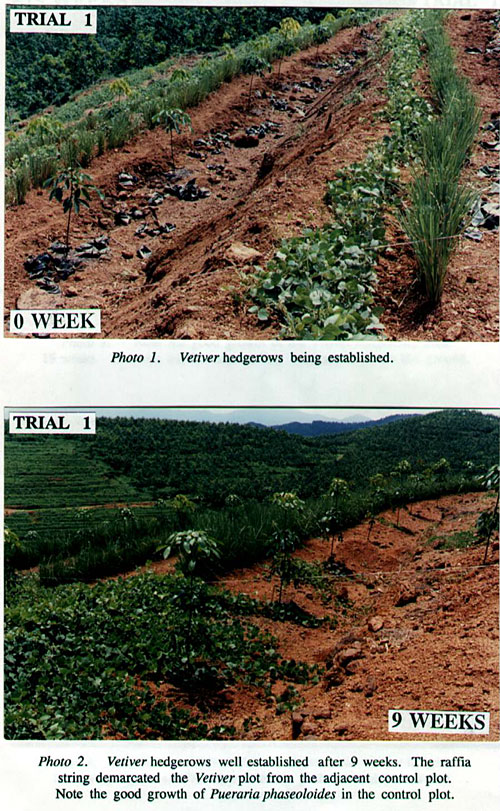    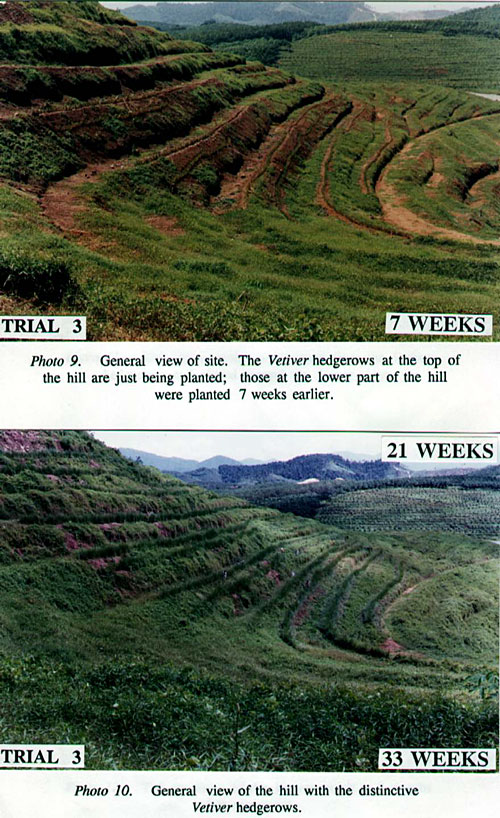 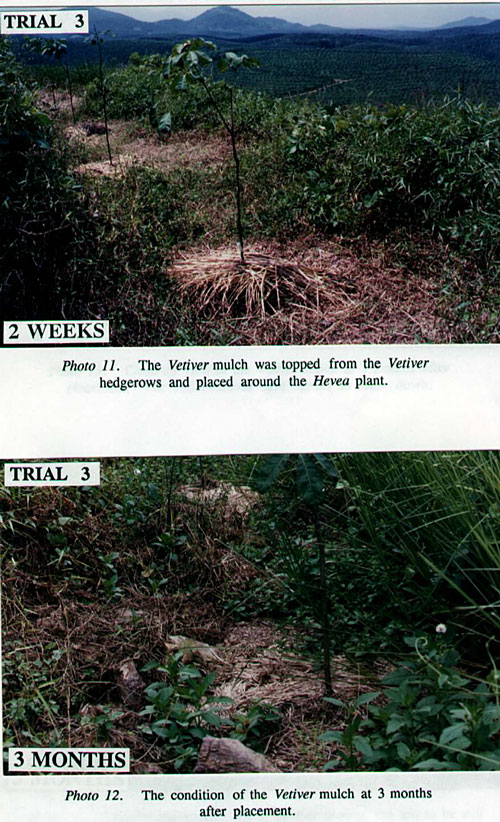     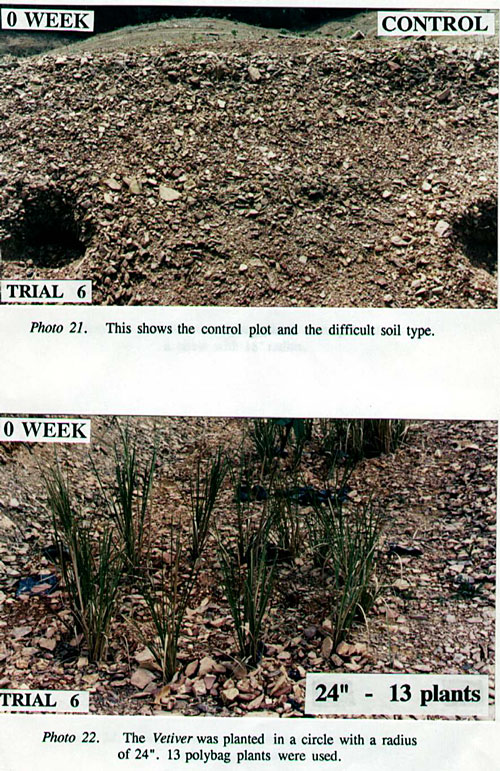 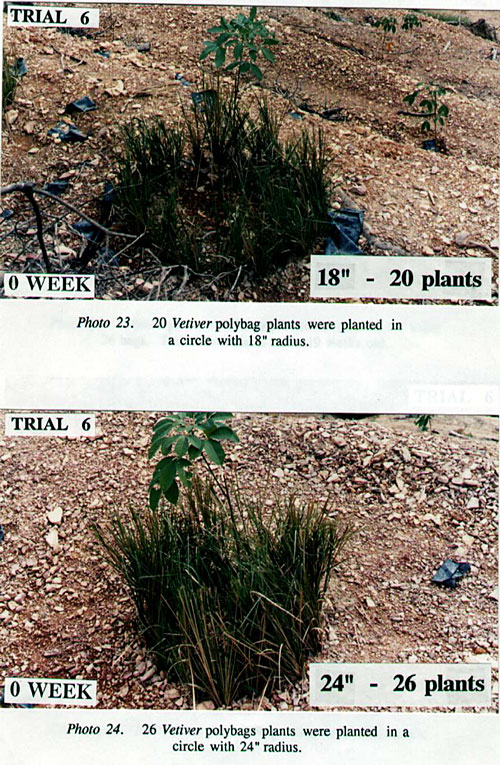 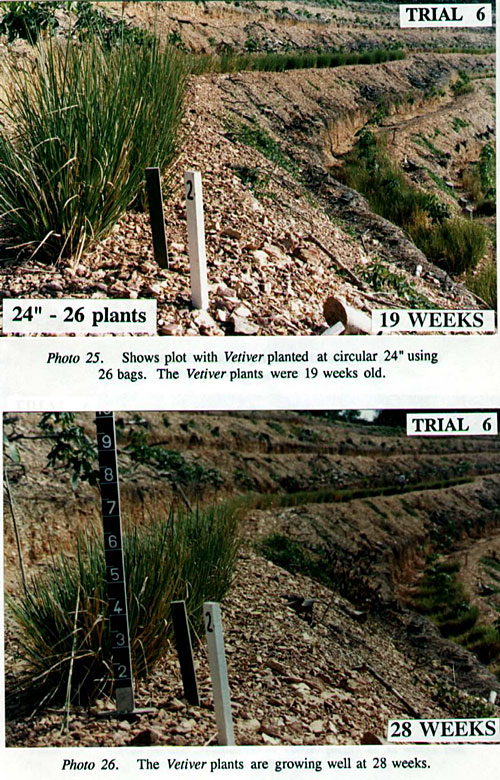 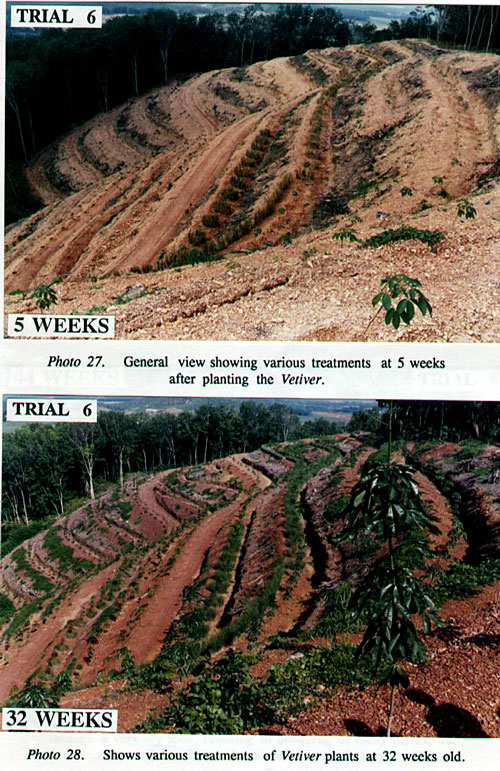   TABLE 1 EFFECT OF VETIVER PLANTING ON HEVEA GROWTH AT VARIOUS MONTHS AFTER TREATMENT
TABLE 2 EFFECT OF VETIVER PLANTING ON HEVEA GROWTHAT VARIOUS MONTHS AFTER TREATMENT
Means with the same subscript alphabets are not significantly different at P<0.05 TABLE 3 EFFECT OF VETIVER PLANTING ON HEVEA GROWTH AT VARIOUS MONTHS AFTER TREATMENT
Means with the same subscript alphabets are not significantly different at P<0.05 TABLE 4 EFFECT OF VETIVER PLANTING ON HEVEA GROWTH AT VARIOUS MONTHS AFTER TREATMENT
Means with the same subscript alphabets are not significantly different at P<0.05 TABLE 5 EFFECT OF VETIVER PLANTING ON HEVEA GROWTH AT VARIOUS MONTHS AFTER TREATMENT
Average over 3 scions |
|||||||||||||||||||||||||||||||||||||||||||||||||||||||||||||||||||||||||||||||||||||||||||||||||||||||||||||||||||||||||||||||||||||||||||||||||||||||||||||||||||||||||||||||||||||||||||||||||||||||||||||||||||||||||||||||||||||||||||||||||||||||||||||||||||||||||||||||||||||||||||||||||||||||||||||||||||||||||||||||||||||||||||||||||||||||||||||||||||||||||||||||||||||||||||||||||||||||||||||||||||||||||||||||||||||||||||||||||||||||||||||||||||||||||||||||||||||||||||||||||||||||||||||||
