|
2.1 EFFECT OF BAG SIZES ON ESTABLISHMENT OF QUALITY VETIVER HEDGEROWS The total cost of establishing hedgerows using polybag plants will be affected by cost of:
A trial was therefore started to assess the practicality and cost-effective reduction in possible bag sizes, without compromising the quality and speed of hedgerow formation. Five bag sizes holding different weights of soil were used. The details of trial are given in Photo 1. The planting distance was kept at a constant 15cm between clumps (Photo 1). Fertilizer application was 1 Kokei (6 gm) per point at the time of planting and then
RESULTS In the First Progress Report, the results on timing of planting were given. Also the dry weights of tips and inter-clump gaps at monthly intervals were given for the first 5 months. Additional data are now available. In this Report, the first 5 months data are reproduced to allow continuity of reporting. (a) Photographic Records Photo 1 Shows the good hedgerow already formed after only 8 weeks growth. Photo 2 Shows how topping was done at 40 cm and the severed tops were used to measure the growth rates. The inter-clump gaps, clearly seen in the photo, wee measured at each topping. Photo 3 Shows the hedgerow after 16 weeks, with one treatment already topped to measure dry matter production. (b) Inter-clump Gaps The gaps in the hedgerow were measured at monthly intervals. It is interesting to note that the plot coefficient of variance (c.v.) increases with the months after planting (Table 1). This should be expected, as the error of measurement will increase, as the absolute value becomes smaller. C.V.s of the first 6 months are readily acceptable while those of 7 – 9 months are tolerable. However, the data from 10 and 12 months are too variable. Thus the validity of the mean as an indicator is questionable and gap measurement for planting distance of 15 cm should not be considered after 9 months. At the beginning, the inter-clump gap size was determined by the different bag sizes since the planting distance was constant. Later, any change would be due to the different growth rates of plants from different polybag sizes. These measurements are given in Table 2. As expected, the larger bag-size plants have lower inter-clump gap sizes than the smaller ones (Table 2 and Figure 1). The 4" x 6" bag size clumps started with gaps larger than the 3 bigger bags (5" x 7", 6" x 9" and 6" x 13"), but from the fourth month, the different gap sizes are generally not polybag size –dependent. It is rather surprising that the 4" x 7" bag size plants produce consistently highter inter-clump gaps than those plants raised in 4" x 6" bag size (although the difference was not significant) and was significantly worse thant 5" x 7", 6" x 9" and 6" x 13" for the first eight months. Table2 also summarises the gap reductions between measurements. Other than the period of 2-3 months after planting they are not influenced by the original bag sizes used. This suggests that the clumps were growing (expanding) at the same rate, though they may have originated from different bag sizes. Growth Rates The tops above 40 cm were cut and the dry weight determined. For the first10 months this was done monthly, thereafter, it was carried out at 2 monthly intervals till the trial stopped at 16 months. The results are given int Table 3 and Figure 2. Other than the first month’s measurements, the top dry weights from all bag sizes were not significantly different. DISCUSSION AND CONCLUSION In using quality polybag plants, the transplanting success was 100%. However, the trial did not include a treatment of using slips of newly cut tillers. Another weakness in the trial is the absence of measurement of the dry weights of tops and roots of plants raised in different bag sizes before transplanting to the ground. These two points should be included in subsequent trials involving different cultivars. Despite the limitations in the trial, the results showed that plant growth is the smallest bag size treatment of 4" x 6" produced similar inter-clump gap size from the fourth month and similar dry matter production from the second month after planting. Thus, the conclusion is that the small bag size of 4" x 6" could be the most economical size for fast and good establishment of Vetiver hedgerows. My earliest work uses 6" x 9" bags holding 1486 gm of soil per bag. This was later changed to 5" x 7", thus reducing the weight to 837 gm. Now the weight could be further reduced to 401 gm per bag. This weight decrease is substantial especially when plants have to be transported from central nurseries to field sites over long distances.   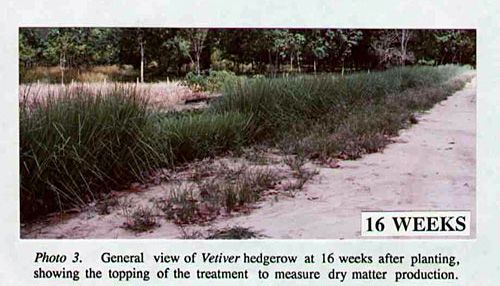 back TABLE 1 EFFECT OF BAG SIZES ON CV (%) OF GAPS IN VETIVER HEDGEROW
TABLE 2 EFFECT OF BAG SIZES ON INTER-CLUMP GAPS AND GAP REDUCTIONS (CM) IN VETIVER HEDGEROW
Note 1: Means with the same subscript alphabets are not significantly different at P<0.05 Note 2: Data on 10 and 12 months are too variable and should
not be used. It is presented here just for records. TABLE 3 EFFECT OF BAG SIZES ON DRY WEIGHTS (G) OF TOPS IN VETIVER HEDGEROW
Cutback at 40 cm height  back  |
|||||||||||||||||||||||||||||||||||||||||||||||||||||||||||||||||||||||||||||||||||||||||||||||||||||||||||||||||||||||||||||||||||||||||||||||||||||||||||||||||||||||||||||||||||||||||||||||||||||||||||||||||||||||||||||||||||||||||||||||||||||||||||||||||||||||||||||||||||||||||||||||||||||||||||||||||||||||||||||||||||||||||||||||||||||||||||||||||||||||||||||||||||||||||||||||||||||||||||||||||||||||||||||||||||||||||||||||||||||||||||||||||||||||||||||||||||||||||||||||||