|
II. GROWTH OF VETIVER AND ITS EFFECT ON FILLED EARTH It is a statutory requirement of the Department of Environment that all latex concentrate factories must discharge their effluent in a designed effluent pond system. The construction of a new factory in a co-operating estate necessitates the ponding to be done with bunds of filled earth. This gave us a good opportunity to test the value of Vetiver to control soil erosion.
Three attempts were made:
Observations and results The plants established very well rapidly, but heavy rainfall on the following days:
caused the bunds to collapse on the evening of 11/10/1990 and the morning of 12/10/1990. (a) Demonstration Plot This was set up with no intention of any measurement. Photo 38 shows the position at planting. Photo 39a and 39b show collapse, but notice the row alignments of planting were barely out. The whole collapse was due to sub-soil collapse as shown in Photo 40. Trial 1 This trial was initiated to have more detailed measurements of surface water run off, soil wash, etc. The details are given below Photo 41, which shows the condition at planting. The experimental plots were demarcated by zinc-sheet boundaries to measure surface water run off and soil wash into the drums (Photo 42a). At each level, there were three marked wooden pegs to measure topsoil loss. Measurements were conducted for a few days but with the heavy rain on 11/10/1990, the drums were washed away and the zinc boundaries collapsed leading to extensive leakage (Photo 42b). It is not possible to repair this and the trial had to be abandoned. However, Photo 42b had demonstrated the better effect of Vetiver to reduce topsoil erosion when compared with estate practice. 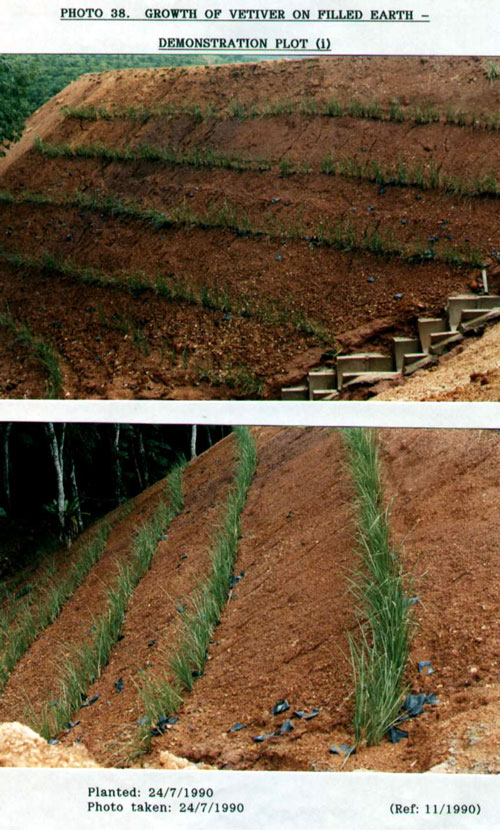 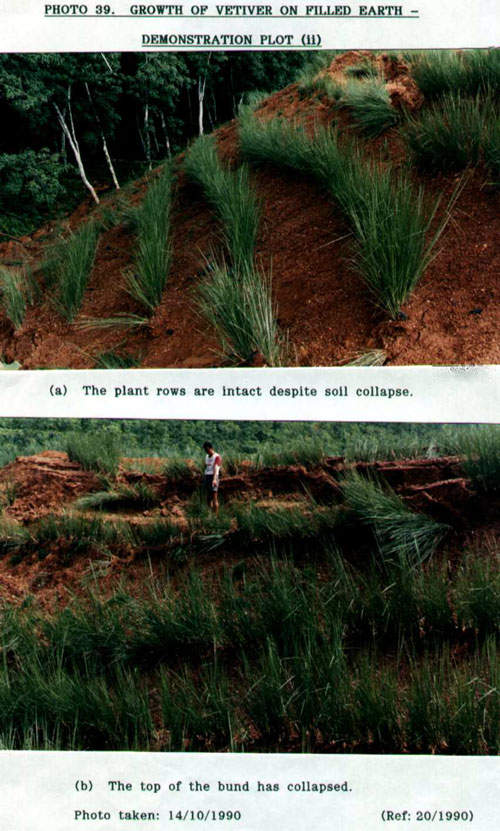  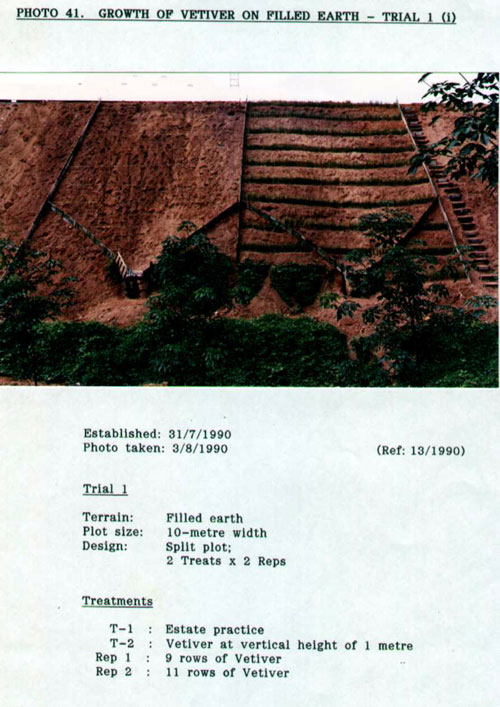 
Trial 2 This trial was on bunds where filled earth which has been established for about a month earlier, to being immediately piled on at time of planting of Vetiver. The details of the trial is given below Photo 43, which shows the replicate block on the older filled soil. The well established Vetiver plants as compared with estate treatments are clearly shown. After the collapse on 11-12/10/1990 the interesting phenomenon was that the alignment of Vetiver planting held very well thought he whole top area of soil in the plots had slipped down (Photo 44a). In the plot with the latest constructed bund, the plants have been dropped more than 4-5 metres (Photo 44b). Closer examination of the various plots showed that the Vetiver planted on the oldest filled soil held well (Photo 45a) and continued to do so (Photo 45b). Such observations confirm that the root system of Vetiver was established most rapidly and have penetrated and held approximately one foot of soil. This trial was abandoned but the earliest planted block continues to show the better value of Vetiver to reduce soil erosion, as compared to normal practice of using cow grass and New Guinea grass (Photo 45b).  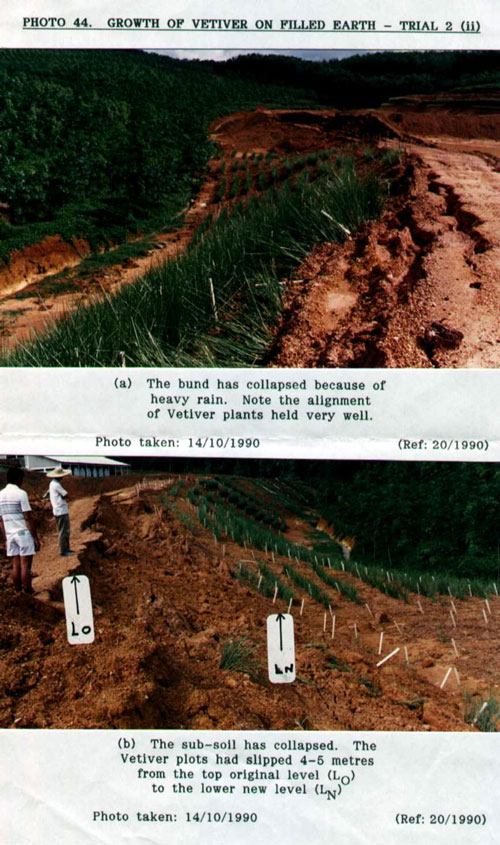 
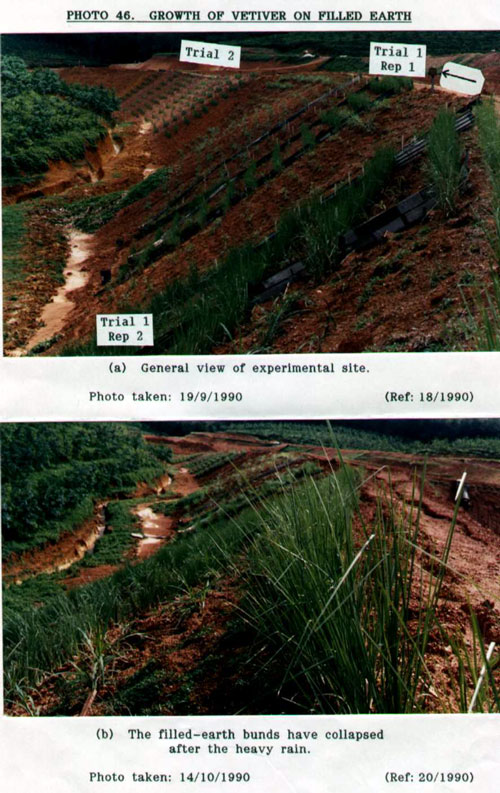
CONCLUSION A large effort, in terms of labour and finance, was expanded on the demonstration plot and the two trials. The collapse of the filled-earth bunds was a big disappointment to us. However, rather than showing the failures of the Vetiver system, it tended to show it’s intrinsic strength. This is best illustrated in the overall picture. Photo 46a shows the general view of the two trials. The direction of the earthwork and the planting of the Vetiver is indicated by the arrow (® ). This shows the size of the trials and the slope and height of the filled earth bunds; Photo 40b shows the collapse of the bunds. Because of the great height and steep slope, we were too optimistic not to have taken care of the subsoil and the poor physical structure by piling. A combination of some structural work and planting of Vetiver may have overcome the collapse of the bund. The main conclusions were:
Nevertheless, the results are so encouraging that the owner intends to repeat and expand the use of Vetiver and has offered additional and increased amounts of funding for my future observations.
 |