|
III EFFECT OF BAG SIZES ON GROWTH OF VETIVER HEDGEROWS
While it would be cheapest to plant Vetiver slips directly
on to grow, such approach invariably results in:
- requirements for replacement of dead plants
- filling of gaps of less vigorous growing slips
- slower establishment
- less uniform establishment
Under certain conditions as highway embankments, steep slopes
in housing estates, etc., it would be more advantageous and possibly
more cost-effective to use polybag plants. This ensures virtually
100% survival, fast establishment and good uniformity; producing
the best hedgerows in the shortest time.
The cost of establishing hedgerows using polybag plants will
be affected by cost of:
- bags
- filling the bags
- digging the trench
- planting the polybag plants.
A trial was therefore started to assess the maximum reduction
in bag sizes possible without compromising the quality and speed
of hedge formation.
Four bag sizes were used and the details of trial are given
and illustrated in Photo 21. Fertilizer application
was 1 Kokei per bag at the time of planting. The planting distance
was kept at a constant six inches between clumps.
The times for digging the trench and for planting were taken.
This is given in Table 6. Timing studies show that
only the larger sized bags of 6" x 13" take significantly
longer time to be planted and for the deeper trench to be dug.
The other plants in the smaller sized bags have similar time
requirements.
To assess growth rates, two measurements were taken at monthly
intervals:
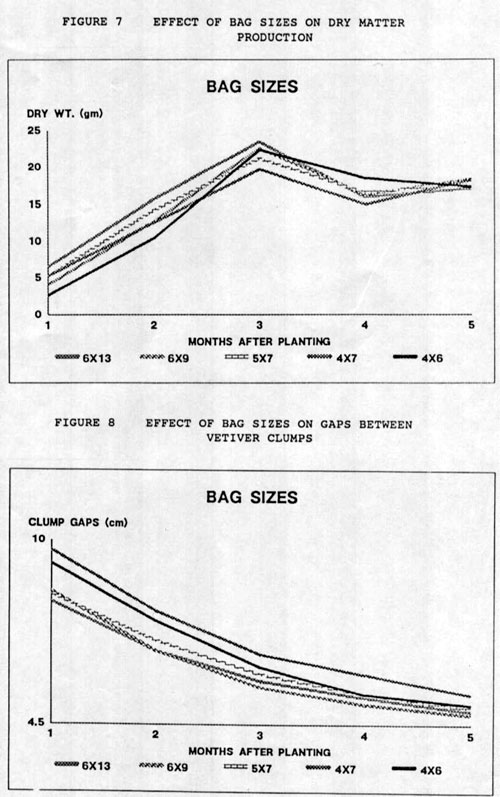
- The tops above 40 cm were cut (Photo 22). The
dry weights are given in Table 7 and illustrated
in Figure 7. Other than in the first month, the
amount of dry matter production is similar for plants originating
from all bag sizes.
- Gap measurements show that the original larger polybag sizes
produce smaller gaps (Table 8 and Figure 8). However,
the gaps diminish with time and the differences between the different
treatments also narrowed.
Tentative conclusion at this stage suggests that the smaller
sized bags of 4" x 6" could be the most economical
size for fast and good establishment of Vetiver hedgerow. The
experiment continues.
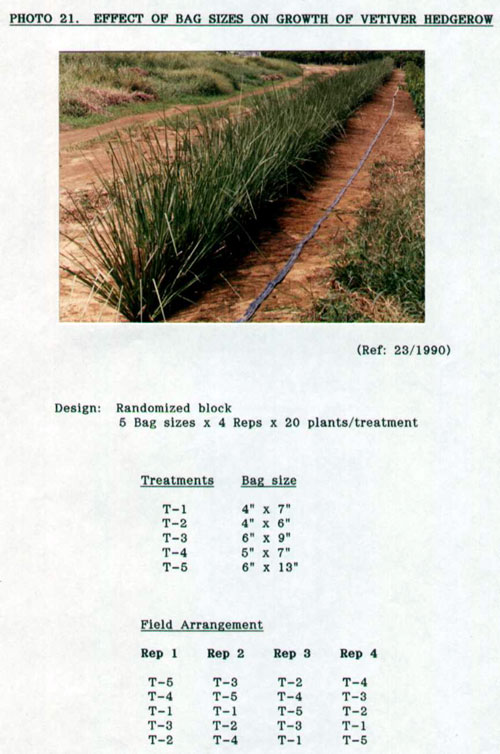
TABLE 6 EFFECT OF BAG SIZES ON RATE OF ESTABLISHMENT
OF VETIVER HEDGEROW.
|
|
Actual field planting
Time taken per plot (20 points) in minutes Mean (min : sec) |
|
Bag sizes (inches) |
Digging |
Planting |
Total |
|
6 x 13 |
9.32 (09:19) a |
11.31 (11:18) a |
20.63 (20:38) a |
|
6 x 9 |
6.00 (06:00) b |
8.69 (08:42) b |
14.69 (14:42) b |
|
5 x 7 |
5.42 (05:25) b |
8.13 (08:08) b |
13.55 (13:33) bc |
|
4 x 7 |
5.21 (05:13) b |
9.05 (09:03) b |
14.26 (14:16) b |
|
4 x 6 |
3.93 (03:56) b |
7.25 (07:15) b |
11.18 (11:11) c |
|
s.e. (± ) |
0.714 |
0.596 |
0.928 |
|
LSD (P<0.05) |
2.33 |
1.94 |
3.03 |
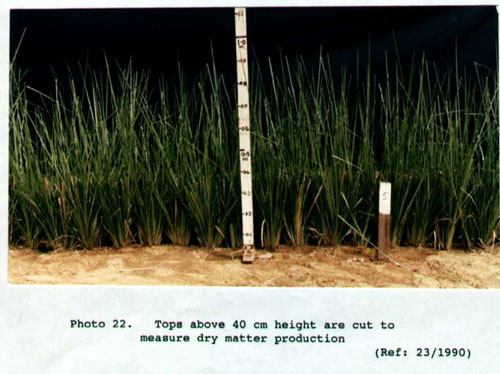 TABLE 7 EFFECT OF BAG SIZES ON DRY MATTER PRODUCTION
OF VETIVER HEDGEROW
TABLE 7 EFFECT OF BAG SIZES ON DRY MATTER PRODUCTION
OF VETIVER HEDGEROW
|
|
|
Dry weight of tops (gm) |
|
Bag sizes (inches) |
1st month |
2nd month |
3rd month |
4th month |
5th month |
|
6 x 13 |
6.51a |
15.7 |
23.5 |
16.0 |
17.1 |
|
6 x 9 |
4.09 bc |
12.7 |
22.6 |
16.3 |
18.4 |
|
5 x 7 |
5.25 ab |
14.2 |
21.2 |
16.6 |
17.8 |
|
4 x 7 |
5.27 ab |
12.5 |
19.7 |
15.0 |
18.3 |
|
4 x 6 |
2.61 c |
10.4 |
22.4 |
18.5 |
17.4 |
|
s.e (± ) |
0.592 |
1.314 |
2.10 |
1.37 |
1.64 |
|
LSD (P<0.05) |
1.82 |
- |
- |
- |
- |
TABLE 8 EFFECT OF BAG SIZES ON INTERCLUMP GAP OF VETIVER
HEDGEROW
|
|
|
Inter-clump gap measurements (cm) |
|
Bag sizes (inches) |
1st month |
2nd month |
3rd month |
4th month |
5th month |
|
6 x 13 |
8.2 b |
6.7 b |
5.8 bc |
5.3 b |
4.9 b |
|
6 x 9 |
8.5 b |
6.7 b |
5.6 c |
5.1 b |
4.8 b |
|
5 x 7 |
8.4 b |
7.0 b |
6.0 bc |
5.4 b |
5.0 ab |
|
4 x 7 |
9.7 a |
7.9 a |
6.6 a |
6.0 a |
5.4 a |
|
4 x 6 |
9.3 a |
7.6 a |
6.2 ab |
5.4 b |
5.1 ab |
|
s.e. (± ) |
0.20 |
0.17 |
0.15 |
0.14 |
0.15 |
|
LSD (P<0.05) |
0.6 |
0.5 |
0.5 |
0.4 |
0.4 |
 |