|
I. EFFECT OF SHADE ON GROWTH OF VETIVER
To be able to use a plant as a cover crop for any extended
period under perennial crops, such as rubber or oil palm, dictates
that the plant must be shade-tolerant under the canopy of the
main crop. Three trials were started to test such effect.
a. Trial 1
Plants raised in polybags for 6 weeks, were put under shade
(80%) of rubber plants at nursery spacing of 6' x 6' and in the
full sun.
At three months after treatment, samples of leaves were taken
from two levels of the leaves to determine specific leaf areas.
Results are given in the following Table 2.
TABLE 2. SPECIFIC LEAF AREA (LA/LW, cm2/gm)
|
|
20-40cm |
40-60cm |
|
|
Shade |
Sun |
Shade |
Sun |
|
Mean |
157.0 |
139.8 |
151.4 |
142.1 |
|
s.e.(± ) |
3.98 |
2.07 |
4.00 |
2.55 |
|
n |
10 |
10 |
10 |
10 |
|
t-test |
*** |
P<0.1 |
Shading significantly increases the specific leaf area suggesting
significant response of the plant.
At three and four months after treatments, ten polybags each
were sampled and the soil washed off (Photo 15).
Results of number of tillers and dry weights are given in Table
3. This shows that shading significantly reduces:
- Tiller formation
- Plant weight
- Shoot weight
- Root weight
But did not modify the % of the root / shade ration significantly.
Therefore, we can conclude that Vetiver (at least the cultivar
I have been working with) is not shade tolerant. It is, however,
not expected to be since most grasses are likely to be climax
plants. The good feature is that the % root / shoot stayed rather
constant and we should be able to modify agricultural methods
to make the best use of this point.
b Trial 2
The plants from Trial 1 were used in this trial. Half the
plants grown under shade were shifted to the open, while the
reverse approach was applied to plants grown in the full sun.
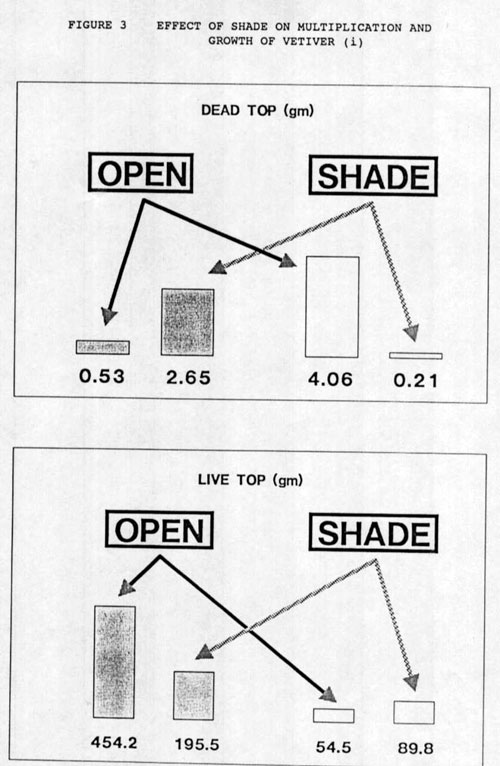
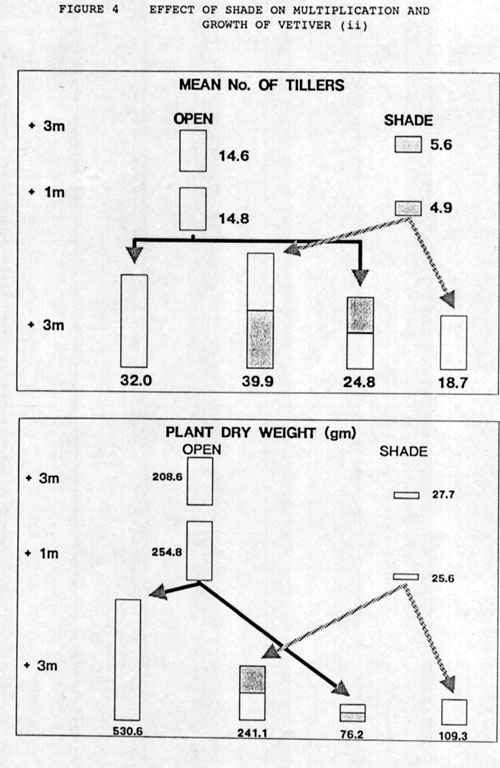
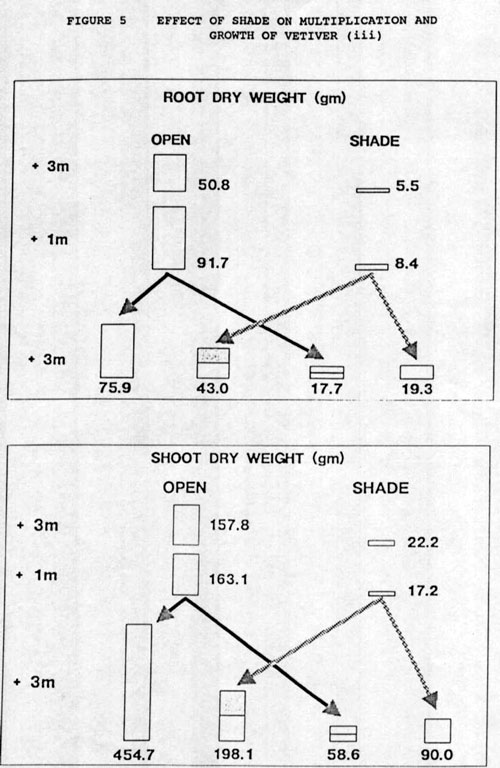
After three months, 15 polybag plants were harvested (Photo
16). The results are summarised in Table 4 and illustrated
in Figure 3. They showed the following:
- Plants from the open performed poorly under shade.
- Plants in shade conditions continued to grow poorly with
poor tillering under continuous shade.
- Plants from shade condition performed well once they are
exposed to the open.

TABLE 3 EFFECT OF SHADE ON MULTIPLICATION AND GROWTH OF VETIVER
(Trial 1)
|
Parameter |
Harvest 1 : at 3 months |
Harvest 2: at 4 months |
|
|
Shade |
Sun |
Sig. Level of t |
Shade |
Sun |
Sig. Level of t |
|
Number of tillers |
5.6 ± 0.95 |
14.6 ± 1.16 |
*** |
4.9 ± 0.4 |
14.8 ± 0.80 |
*** |
|
Total shoot dry wt. (gm) |
22.2 ± 3.08 |
157.8 ± 17.03 |
*** |
17.2 ± 1.54 |
163.1 ± 16.05 |
*** |
|
Total root dry wt. (gm) |
5.5 ± 1.04 |
50.8 ± 6.72 |
*** |
8.4 ± 1.61 |
91.7± 13.18 |
*** |
|
Total plant dry wt. (gm) |
27.7 ± 3.97 |
208.6 ± 23.10 |
*** |
25.6 ± 2.68 |
254.8 ± 26.58 |
*** |
|
% root / shoot |
25.2 ± 2.59 |
31.9 ± 2.49 |
P<0.1 |
49.3 ± 9.61 |
57.1 ± 7.77 |
NS |
Note: 2-tail test is used *** P<0.001 NS: Not significant
TABLE 4 EFFECT OF SHADE ON MULTIPLICATION AND GROWTH OF VETIVER
(Trial 2).
|
|
|
|
|
Dry weights (gm) |
|
|
|
Comparisons |
Mean No. of tillers |
Dead shoot |
Live Shoot |
Root |
Shoot |
Total Plant |
Root
%------------
Plant |
Dead Shoot
%------------
Total Shoot |
|
T2 vs T1 |
Cont. open
Cont. shade
Sig. of t |
32.0
18.7
* |
0.53
0.21
ns |
454.2
89.8
* |
75.9
19.3
* |
454.7
90.0
* |
530.6
109.3
* |
14.5
18.0
** |
0.09
0.19
ns |
|
T2 vs T3 |
Cont. open
Open ® shade
Sig. of t |
32.0
24.8
ns |
0.53
4.06
** |
454.2
54.5
** |
75.9
17.7
* |
454.7
58.6
** |
530.6
76.2
** |
14.5
23.6
*** |
0.09
7.62
** |
|
T2 vs T4 |
Cont. open
Shade ® open
Sig. of t |
32.0
39.9
ns |
0.53
2.65
* |
454.2
195.4
* |
75.9
43.0
P<0.1 |
454.7
198.1
* |
530.6
241.1
* |
14.5
17.9
* |
0.09
1.52
** |
|
T1 vs T3 |
Cont. shade
Open ® shade
Sig. of t |
18.7
24.8
* |
0.21
4.06
** |
89.8
54.5
** |
19.3
17.7
ns |
90.0
58.6
** |
109.3
76.2
* |
18.0
23.6
*** |
0.19
7.62
** |
|
T1 vs T4 |
Cont. shade
Shade ® open
Sig. of t |
18.7
39.9
*** |
0.21
2.65
** |
89.8
195.4
*** |
19.3
43.0
*** |
90.0
198.1
*** |
109.3
241.1
*** |
18.0
17.9
ns |
0.19
1.52
* |
|
T3 vs T4 |
Open ® shade
Shade ® open
Sig. of t |
24.8
39.9
** |
4.06
2.65
ns |
54.5
195.4
*** |
17.7
43.0
*** |
58.6
198.1
*** |
76.2
241.1
*** |
23.6
17.9
*** |
7.62
1.52
** |
Note: T1 – continuous shade
T2 – continuous open
T3 – open ® shade
T4 – shade ® open
t – test using pooled or separate variance estimate
Therefore, the conclusion is:
"Vetiver is not shade-tolerant" but can survive
under shade (intensity?) for a period (?) and could easily rejuvenate
if the shading canopy is removed.
In effect, such information allows us to plan the following:
- Plant the Vetiver before or at the same time as the
planting of the main perennial crop of oil palm or rubber.
- Leave the Vetiver along the terracing to grow or sustain
itself.
- When the main crops of oil palm or rubber have grown over,
the rows of Vetiver can either perish as in oil palm area or
periodically be re-established as in rubber during wintering.
In either case, the Vetiver would have done its job of reducing
soil erosion.
c. Trial 3
This trial studied the growth of plants under very intense
shade of (87%) of rubber nursery and also examined three possible
methods of establishing plants in the field.
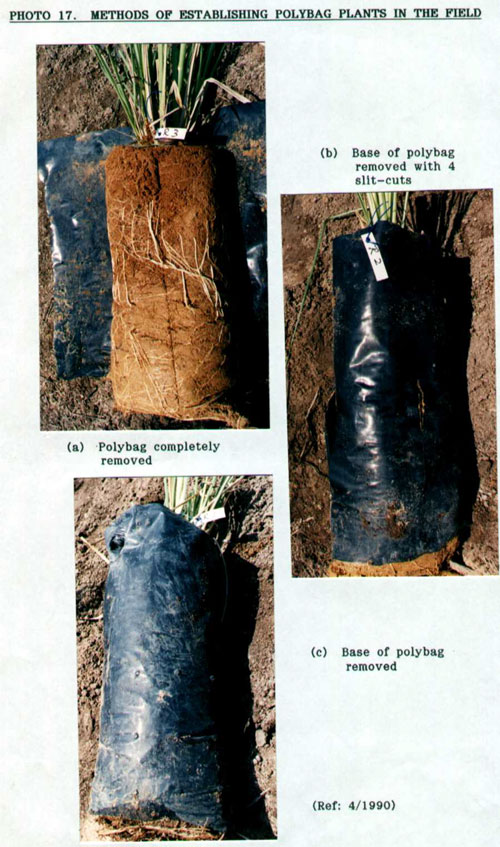
The three planting methods are:
- polybag completely removed exposing the core of soil and
roots (Photo 17a).
- base removed and with four slits cut with 10 cm clearance
from top and bottom (Photo 17b).
- base of polybag removed (Photo 17c).
Photo 18a shows the condition of plants at planting
and Photo 18b shows the condition after two months
in the open. In contrast, Photo 19a shows the condition
of plants after two months in the shade of rubber canopy (Photo
19b).
Value of the three planting methods will be discussed separately.
Here, it is of significant note that all three methods of planting
have no influence on the intense shade effect, vis. All plants
under rubber performed badly at two months (Photo 19a)
compared with those in the open (Photo 18b). Eventually,
all the plants under the intense shade died off.


The following points are of note:
- Normally, the % shade under mature rubber is not
so intense
- The attempt to raise polybag plants to establish under established
shade has to be re-examined. Direct planting in situ in
the ground before shading by the main crop may modify the response.
CONCLUSION
The following points should be noted:
- Very intense shade was used. This is of value to study shade
tolerance at the preliminary stage; but normal shade in rubber
is not so intense.
- Because of (1), it is important to study response to various
intensity of shading. This is easy to do, using available plastic
nets but we have delayed this to combine with studies of different
cultivars for more meaningful results.
- Polybag materials were established under existing shade.
The root system at establishment was confined within the bag
and therefore may not be best expressed. Would the planting "in
situ" before canopy closure performed the same?
- Nevertheless, all evidences point to Vetiver being shade-sensitive.
At what level of shade would tolerance be possible?
- However, because of (4), the possible value of Vetiver may
be manipulated in the following manner:
Because of the shade sensitivity and the possible competitive
effectiveness of Vetiver against perennial crops as rubber, oil-palm,
fruit trees, etc.
Vetiver should be used for:
i) early function for soil and moisture conservation.
ii) allow the Vetiver plants to fade out because of shading so
as to remove any possible competitive effect with the main crops.
- Trial 2 showed that plants poorly grown under shade were
rapidly revived upon exposure to light. This suggests shade survival
may be dependent on the degree of shading, and with the periodic
dose of more light as during winter period in rubber.
- Vetiver will not be shaded out in crops that do not produce
dense canopies or are relatively short. Examples are cocoa, tea,
etc.
|