|
III. MULTIPLICATION BY CULM-CUTTINGS It is recommended that clumps of Vetiver be cut-back to 30-50 cm to encourage tillering. Early observations suggest that too short cut-backs result in die back of many culms under Malaysian conditions. An ad hoc trial, testing 30, 40, 50 and 60 cm cut-back height suggested 40 cm to be the best with least set-back to growth, minimum die-back and good tillering. The tops are normally discarded after cut-back at 40 cm height. However, if the Vetiver clumps are 3 months or older, the cut-tops include many culms. Each culm, has varying numbers of internodal buds which can be induced to sprout and produce new plantlets under mist. Three methods of rooting under mist were tested. (1) Layering of culms. The whole stem was buried in sand-bed with the following results after 5 weeks:
(2) Rooting of individual node with leaf-sheath intact (Photo 9). Rooting success:
(3) Rooting of individual node with leaf-sheath slit. Rooting success:
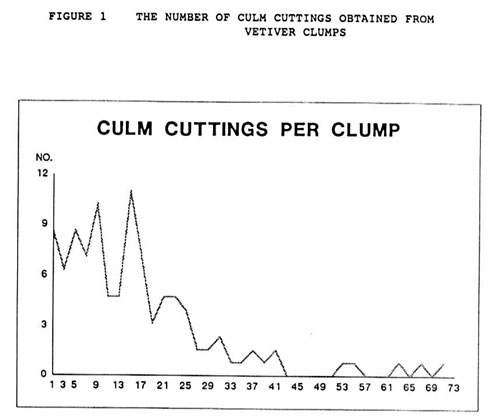
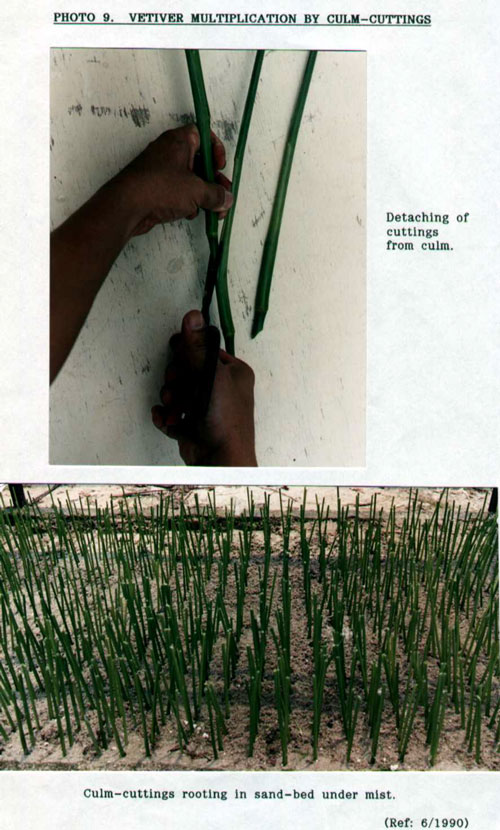 Treatment (3) of rooting each nodal culm, cutting with the led-sheath slit was the most promising. An assessment of 5-month old clumps in the ground yielded 16.4 + 1.35 cuttings. The number of cuttings from each clump is highly variable as shown in Figure 1. It is for note that the above work was done under mist. However, based on experience with other crops, similar results would likely be obtained if materials are rooted in sand-bed under polythene sheet to keep the atmosphere moist; this has not been specifically tested because of time constraint. CONCLUSION Vetiver is easy to multiply at low cost. Under normal conditions, multiplication by planting with tillers will give satisfactory results. However, refined methods of vegetative propagation by culm branches and culm cuttings may be considered from 2 view points:
Certainly these methods are much cheaper than the tissue culture method. However, once the base source for multiplication is established, the normal method of splitting the tillers should suffice. In the early phase of my work, all methods using all plant parts are used. This accounts for the large amount of materials produced and distributed (see Chapter B).
|